


Digestive symptoms are notoriously hard to pin down. Bloating, stomach pain, heartburn, diarrhoea, and constipation can each come from dozens of different causes, and the same symptom can mean something harmless in one person and something that needs treatment in another.
That’s why digestive disorder diagnostic tests exist. They take the guesswork out of the picture and help your doctor find what is actually going on.
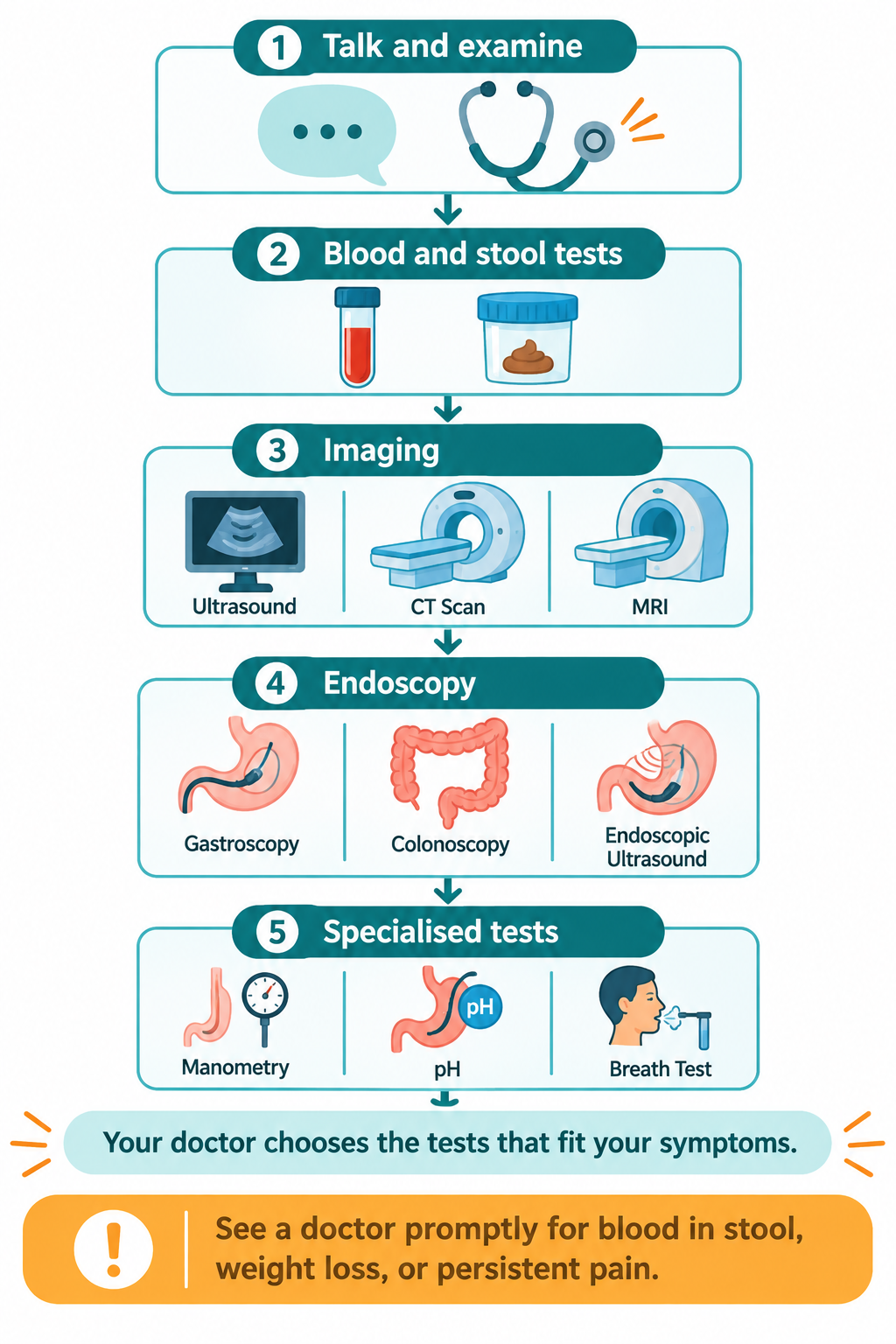
The tests your gastroenterologist chooses aren’t the same for everyone. They depend on your symptoms, your medical history, and what the examination shows. This guide walks you through the main options, from simple blood and stool tests to imaging and endoscopy, so you know what each one does, how to prepare, and what to expect.
What Are Digestive Disorder Diagnostic Tests?
Digestive disorder diagnostic tests, sometimes called digestive health tests or gastrointestinal diagnostic tests, are the investigations doctors use to find the cause of symptoms affecting the digestive system.
That system runs from your mouth to your bowel, and includes the liver, gallbladder, and pancreas, so the range of tests is wide.
They matter for three main reasons. First, they confirm or rule out a diagnosis, so treatment can target the right problem.
Second, they pick up conditions that don’t announce themselves clearly, such as coeliac disease, inflammatory bowel disease, or early bowel problems. Third, they can provide reassurance.
A normal result is genuinely useful, because it lets your doctor move on from worrying causes and focus on the likelier ones.
Different patients need different tests because no two people present in exactly the same way. A 25-year-old with bloating needs a very different work-up from a 60-year-old with a new change in bowel habits and weight loss. Good diagnosis is about choosing the right tests, in the right order, for the right person.
When Should You Get Tested for Digestive Problems?
Not every digestive complaint needs testing. Occasional indigestion or a short bout of diarrhoea usually settles by itself. But some patterns are worth investigating. Here are the situations where tests for stomach problems are most often considered.
Persistent Abdominal Pain or Stomach Discomfort
Pain that keeps coming back, lasts for weeks, or is getting worse deserves an explanation. Tests for persistent abdominal pain range from blood tests to scans and endoscopy, depending on where the pain is and what accompanies it.
Frequent Bloating, Gas, or Indigestion
Occasional bloating is normal. Frequent bloating, especially with pain, weight loss, or changes in bowel habits, may point to conditions such as coeliac disease, food intolerances, or bacterial overgrowth.
Ongoing Diarrhoea or Constipation
Either problem, when it lasts more than a few weeks or represents a change from your usual pattern, is a reason to look further, particularly if it comes with weight loss, blood, or night-time symptoms.
Blood in the Stool or Changes in Bowel Movements
Blood in the stool, black stools, or a persistent change in bowel habits should always be assessed. They aren’t always serious, but they should never be assumed to be harmless.
Unexplained Weight Loss or Loss of Appetite
Losing weight without trying, or losing interest in food, is a red flag symptom for many digestive and other conditions, and it needs prompt investigation.
Persistent Heartburn, Acid Reflux, or Difficulty Swallowing
Heartburn that doesn’t settle, or any new or worsening difficulty swallowing, may need endoscopy or specialised tests to find the cause.
How Does a Gastroenterologist Begin Diagnosing Digestive Disorders?
Before any test is booked, the diagnosis starts with a conversation. In fact, for many digestive conditions, the conversation and examination provide the most useful information of all.
Reviewing Your Medical History
Your doctor will ask about your past health, previous surgeries, medicines, allergies, and your family history of conditions such as bowel cancer, inflammatory bowel disease, and coeliac disease. Family history can change which tests are needed and when.
Understanding Your Digestive Symptoms
Expect detailed questions. Where is the pain? What does it feel like? Is it related to food or bowel movements? How long has it been going on?
Has anything changed recently? A symptom diary kept for a couple of weeks makes this much easier and often reveals patterns you hadn’t noticed.
Physical Examination of the Abdomen
The doctor will examine your abdomen, checking for tenderness, swelling, or lumps, and may look for signs elsewhere in the body, such as pallor from anaemia.
Deciding Which Gastrointestinal Diagnostic Tests Are Needed
Using everything above, your gastroenterologist decides which tests will answer the key questions most efficiently. Johns Hopkins Medicine groups digestive diagnostic procedures into lab tests, imaging tests, and endoscopic procedures, and most work-ups draw on a combination. The aim is to avoid both under-testing and unnecessary testing.
Common Blood and Stool Tests for Digestive Disorders
These are usually the first step, because they’re simple, safe, and informative.
Complete Blood Count (CBC)
A CBC measures your red cells, white cells, and platelets. Anaemia can point to bleeding or poor absorption of iron, while a raised white cell count can suggest infection or inflammation.
Liver Function Tests
These measure enzymes and other substances in your blood that show how well your liver and bile ducts are working. Abnormal results can point to liver disease, gallstones, or bile duct problems, and often lead to further tests such as ultrasound.
Inflammatory Markers and Other Blood Tests
Markers such as C-reactive protein can show whether inflammation is present in the body. Doctors may also check iron, vitamin B12, folate, and vitamin D levels, which can be low if the gut isn’t absorbing nutrients properly.
Stool Tests for Digestive Problems
Stool tests can look for infection, hidden blood, and markers of bowel inflammation such as faecal calprotectin, which helps distinguish inflammatory bowel disease from irritable bowel syndrome. Another stool test, faecal elastase, can help assess how well the pancreas is working.
According to the National Institute of Diabetes and Digestive and Kidney Diseases, doctors generally use blood and stool tests, and sometimes other tests, to check for conditions other than IBS, because IBS itself usually isn’t diagnosed by a test.
Helicobacter pylori (H. pylori) Testing
- pylori is a common stomach bacterium that can cause gastritis and ulcers. It can be detected with a stool test, a urea breath test, or a biopsy taken during gastroscopy.
Some medicines, including acid-reducing tablets and antibiotics, can affect the accuracy of these tests, so ask your doctor what to do before testing rather than stopping anything on your own.
Tests for Coeliac Disease
Coeliac disease is screened for with a blood test, and if it’s positive, a gastroscopy with small bowel biopsies is usually done to confirm it. It’s important to keep eating gluten until testing is complete, because removing it beforehand can make results unreliable.
Imaging Tests Used to Diagnose Digestive System Disorders
Imaging lets doctors see organs from the outside, without a procedure inside the body.
Abdominal Ultrasound
Abdominal ultrasound, or sonar, uses sound waves to examine organs such as the liver, gallbladder, pancreas, spleen, and kidneys.
It’s quick, painless, and involves no radiation, which makes it a useful first test for upper abdominal pain, suspected gallstones, and liver problems. Its limits are that gas in the bowel and body build can hide some structures.
CT Scan for Digestive Problems
A CT scan uses X-rays to create detailed cross-sectional images. It’s very good at showing inflammation, abscesses, blockages, masses, and complications, and it’s often used when pain is significant or the cause isn’t clear.
It does involve radiation, and sometimes a contrast dye, so tell your team about any allergies or kidney problems.
MRI and MRCP Scans
MRI uses magnetic fields rather than radiation and gives excellent images of soft tissue. A special type, MRCP, shows the bile and pancreatic ducts clearly without needing an instrument passed into the body.
MRI can also be used to look at the small bowel in conditions such as Crohn’s disease.
When Are Imaging Tests Recommended?
Imaging is usually recommended when the history and examination suggest a problem in an organ rather than the lining of the gut, when there are warning signs such as significant pain, weight loss, or abnormal blood tests, or when endoscopy needs to be complemented by a view of structures outside the bowel.
Endoscopic Procedures for Diagnosing Digestive Disorders
Endoscopy lets the doctor look directly inside the digestive tract with a thin, flexible tube carrying a camera. It’s often the most accurate way to find out what’s happening on the lining, and samples (biopsies) can be taken at the same time.
Gastroscopy: Examining the Upper Digestive Tract
A gastroscopy examines the oesophagus, stomach, and the first part of the small intestine. It’s used to investigate heartburn, difficulty swallowing, upper abdominal pain, nausea, vomiting, anaemia, and suspected coeliac disease or ulcers.
Colonoscopy: Examining the Large Intestine
A colonoscopy looks at the entire large bowel and the rectum. It’s used for rectal bleeding, persistent changes in bowel habits, unexplained anaemia, suspected inflammatory bowel disease, and for bowel cancer screening, since polyps can be removed during the procedure.
Endoscopic Ultrasound (EUS)
Endoscopic ultrasound combines endoscopy with ultrasound to look at the wall of the digestive tract and organs close to it, such as the pancreas and bile ducts, in fine detail. It can also guide a needle to take a sample from a suspicious area.
Small Bowel Evaluation
The small bowel is long and hard to reach, so it needs specialised tests. These may include capsule endoscopy, where you swallow a tiny camera that takes pictures as it travels through you, or specialised scans. They’re used for unexplained bleeding, anaemia, or suspected Crohn’s disease.
ERCP for Bile Duct and Pancreatic Conditions
ERCP combines endoscopy and X-ray to look at the bile and pancreatic ducts. Because it carries more risk than other endoscopic tests, it’s now used mainly when treatment is needed, such as removing a bile duct stone or placing a stent, while MRCP or EUS are often used first for diagnosis.
Specialised Gastrointestinal Tests Your Gastroenterologist May Recommend
When standard tests don’t explain your symptoms, more specialised gastrointestinal function tests can help.
Manometry Tests for Swallowing and Bowel Function
Manometry measures the pressure and coordination of muscle contractions. It can be used in the oesophagus to investigate swallowing problems, and in the rectum and anus to investigate certain bowel and continence issues.
NIDDK notes that manometry tests measure muscle pressure and movements in parts of the digestive tract, such as the oesophagus, small intestine, colon, or rectum. You can read more in our guide to manometry and pH studies.
pH Monitoring for Acid Reflux
pH monitoring measures how often, and for how long, acid reaches the oesophagus. It’s useful when reflux is suspected but not confirmed, or when treatment isn’t working.
Tests for Food Intolerances and Malabsorption
When food seems to trigger symptoms, or the gut isn’t absorbing nutrients properly, targeted tests can help. These include breath tests for lactose and fructose intolerance, blood tests for coeliac disease, and tests for conditions such as bile acid malabsorption, which can cause chronic diarrhoea and affect nutrient absorption.
A word of caution about commercial food-intolerance blood tests, such as IgG panels. They’re widely marketed, but they’re not considered reliable, and an elimination diet guided by a professional is usually more useful.
Breath Tests for Digestive Conditions
Breath tests measure gases in your breath after you drink a special solution. Hydrogen and methane breath tests may be used to look for small intestinal bacterial overgrowth or problems digesting certain carbohydrates, as noted by NIDDK, and a urea breath test checks for H. pylori. Gastric emptying breath tests can show how quickly the stomach empties.
Tests to Evaluate Pancreatic Function
If the pancreas may not be making enough digestive enzymes, tests such as faecal elastase, blood tests, and imaging can help assess it. Persistent greasy, pale, floating stools and unexplained weight loss are the kind of symptoms that prompt this.
How to Prepare for Digestive Disorder Diagnostic Tests
Preparation varies with each test, and your own instructions always come first. Here is the general picture.
Following Instructions Before Blood and Stool Tests
Blood tests may require fasting for some measurements. Stool tests need a clean container and a fresh sample, and some require you to avoid certain medicines or foods beforehand. Follow the lab’s instructions carefully, since errors can affect results.
Preparing for an Abdominal Ultrasound or Imaging Scan
An abdominal ultrasound of the upper abdomen often requires fasting for several hours, and a full bladder may be needed for pelvic scans. For CT or MRI, tell your team about allergies, kidney problems, pregnancy, and any metal implants or devices, especially before an MRI.
Preparing for Gastroscopy and Colonoscopy
For gastroscopy, you’ll usually fast for several hours so your stomach is empty. Colonoscopy requires a bowel preparation, with a special diet and a cleansing solution, to empty the large bowel so the doctor can see clearly. Your doctor will give you written instructions for both, and it’s worth reading them several days ahead.
Understanding Fasting and Medication Instructions
Tell your doctor about every medicine you take, including blood thinners, diabetes medication, iron supplements, and over-the-counter products. Some need to be adjusted, but never stop anything without being told to.
What to Expect After Your Tests
After tests with sedation, you’ll need someone to take you home and you shouldn’t drive for the rest of the day. After most tests you can return to normal activities quickly. Your team will tell you what to watch for and when to expect results.
What Happens After Your Digestive Test Results?
The results aren’t the end of the process, they’re the beginning of the plan.
Your doctor interprets results together with your symptoms and examination, not on their own. A slightly abnormal result might mean nothing in context, and a normal result doesn’t always mean there’s no problem.
That’s why some people need more than one test, and why the first results sometimes lead to further investigation rather than an immediate answer.
It also helps to understand the difference between screening and diagnostic testing. Screening tests, such as colonoscopy at the recommended age, look for problems in people with no symptoms.
Diagnostic tests look for the cause of symptoms you already have. The reasons for doing them, and the timing, are different.
Once a cause is found, your gastroenterologist will use the findings to build a personalised treatment plan, which might include medication, dietary changes, lifestyle measures, further procedures, or ongoing monitoring.
When Should You See a Gastroenterologist for Digestive Problems?
It’s worth booking an assessment if you have:
- Persistent or recurring abdominal pain
- Ongoing changes in bowel habits
- Unexplained weight loss
- Blood in the stool
- Frequent vomiting or difficulty swallowing
- Persistent digestive discomfort that affects your daily life
Seek urgent medical care for sudden severe abdominal pain, vomiting blood, black stools with dizziness or fainting, or a swollen, tender abdomen with fever.
Dr. Preetha Thomas, a specialist physician and medical gastroenterologist in Pretoria, assesses and investigates digestive symptoms and can recommend the right tests for your situation.
If symptoms persist, getting professional advice sooner usually means simpler answers and simpler treatment.
Book a Consultation with Dr. Preetha Thomas
If you’ve been living with digestive symptoms and you’re not sure which tests you need, or whether you need any, a proper assessment is the place to start. Book a consultation with Dr. Preetha Thomas to talk through your symptoms and the next steps.
Frequently Asked Questions About Digestive Disorder Diagnostic Tests
What Is the Most Common Test for Digestive Disorders?
Blood tests and stool tests are the most commonly used first-line tests, because they’re simple and informative. For problems inside the digestive tract itself, endoscopy, such as gastroscopy or colonoscopy, is among the most commonly used and most accurate tests.
Which Tests Check the Overall Health of the Digestive System?
There isn’t a single test that checks everything. Doctors usually combine a history and examination with blood tests, stool tests, imaging, and, where needed, endoscopy, choosing the combination that suits your symptoms.
Are Digestive Diagnostic Tests Painful?
Most aren’t. Blood and stool tests cause little or no discomfort, ultrasound is painless, and endoscopic procedures are usually done with sedation, so you’re comfortable and remember little. Some tests, such as manometry, can feel unpleasant but are brief.
Do All Digestive Problems Require a Gastroscopy or Colonoscopy?
No. Many digestive problems are diagnosed with history, examination, and simple tests. Endoscopy is recommended when symptoms or results suggest it’s needed, such as warning signs, symptoms that don’t respond to treatment, or screening.
How Long Does It Take to Get Digestive Test Results?
It varies. Some results, such as ultrasound findings or endoscopy observations, may be discussed the same day. Blood and stool results usually take a few days, and biopsy results can take a week or more. Your doctor’s rooms will tell you what to expect.
Conclusion: Understanding Your Digestive Health Through the Right Tests
Accurate diagnosis is the foundation of good digestive care. Different conditions need different tests, and the right ones, chosen for you, give clear answers and a better treatment plan than guessing ever could. Most people find that the testing process is far less daunting than they feared, and that the clarity it brings is a relief.
If you have persistent digestive symptoms, don’t ignore them or work around them indefinitely. A professional evaluation is the quickest route to answers. To take that step, contact Dr. Preetha Thomas in Pretoria for a thorough digestive health assessment.
Disclaimer: This article is intended for general informational and educational purposes only. It does not constitute medical advice and should not be used to diagnose, treat, or manage any health condition. Which tests are appropriate depends on your individual symptoms, history, and examination, so always follow the instructions of your treating doctor, and never stop or change a medicine without medical advice. Sudden severe abdominal pain, vomiting blood, black or bloody stools, fainting, or a swollen and tender abdomen with fever need urgent medical care. Please consult Dr. Preetha Thomas or another qualified healthcare professional regarding your specific situation.