

Why Most People Avoid This — And Why That’s a Mistake
Let’sbe honest. Ifyou’vebeen putting off a colonoscopy because the idea makes you uncomfortable,you’renot alone.It’s one of the most commonly recommended — and most commonly avoided — procedures in gastroenterology.
Colonoscopy can detect and remove polyps before they become cancerous — reducing colorectal cancer risk by up to 90%.
Source: American Cancer Society / New England Journal of Medicine
At our practice in Pretoria, we perform colonoscopies regularly at Mediclinic Kloof inErasmuskloof. Patients often tell us afterwards that the anticipation was far worse than the actual experience.Soifyou’vebeen referred for a colonoscopy — oryou’rewondering whether you should be — this guide will walk you through everything, step by step.
What Is a Colonoscopy?
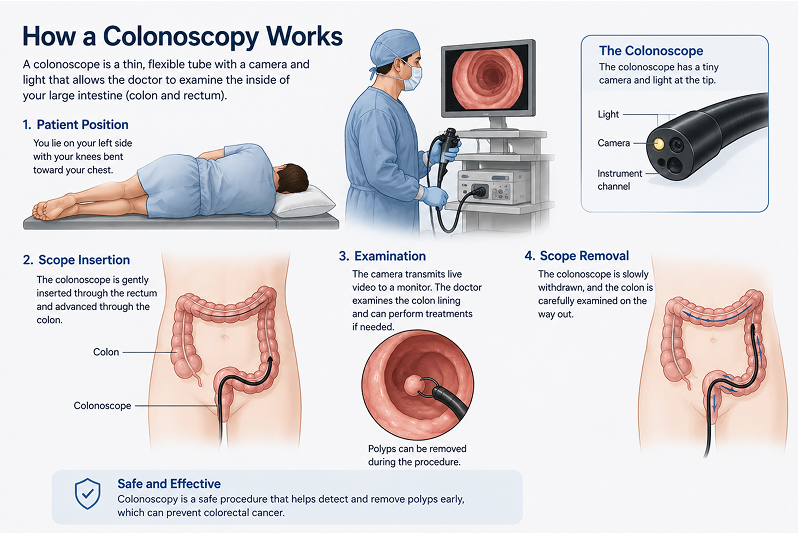
A colonoscopy is a procedure that allows your gastroenterologist to look inside your large intestine (colon) and rectum using a thin, flexible tube called a colonoscope. The colonoscope is about the thickness of your finger, and it has a small camera and light at the tip, giving your doctor a real-time view of the lining of your bowel. Learn more about our colonoscopy service at Mediclinic Kloof.
The procedure lets your doctor:
- Examine the entire lining of your colon for abnormalities
- Detect and remove polyps (small growths that may become cancerous over time)
- Take small tissue samples (biopsies) if anything looks unusual
- Diagnose conditions like inflammatory bowel disease, bleeding, or diverticulosis
- Screen for colorectal cancer — one of the most preventable cancers when caught early
Who Needs a Colonoscopy?
Your doctor or gastroenterologist may recommend a colonoscopy if you have any of the following:
- Unexplained rectal bleeding or blood in the stool
- A persistent change in bowel habits (diarrhoea, constipation, or both)
- Unexplained abdominal pain or cramping
- Unexplained weight loss
- A family history of colorectal cancer or polyps
- Anaemiawith no obvious cause
- Previouspolyps found during an earlier colonoscopy
Screening colonoscopies are also recommended even if you have no symptoms:
- From age 45 if you are at average risk
- From age 40 (or 10 years earlier than a first-degree relative’s diagnosis) if you have a family history
- From age 45 if you are at average risk
Colorectal cancer is the 3rdmost commonly diagnosedcancer worldwide, with over 1.9 million new cases each year.
Source: World Health Organization (WHO), 2022
The good news? When detected early through screening, colorectal cancer has a 5-year survival rate of over 90%. That number drops significantly in later stages. Regular screening is one of the most important things you can do for your long-term health.
How to Prepare for Your Colonoscopy
The preparation — often called “bowel prep” — is the part most patients dread, and wewon’tsugarcoat it: it requires commitment. Butit’salso the most critical part of the process. A poorly prepared bowel can obscure the view and mean your doctor misses something important. In fact, studies show that inadequate preparation reduces polyp detection by up to 46%.
3–5 Days Before: Dietary Changes
You’llbe asked to start adjusting your diet a few days before the procedure:
- Avoid high-fibrefoods like seeds, nuts, whole grains, raw vegetables, and fruit with skins
- Stick to low-residue foods: white bread, white rice, eggs, chicken, fish, plain yoghurt
- Drink plenty of water and clear fluids throughout the day
- Avoid red- or purple-colouredfoods and drinks — these can be mistaken for bleeding during the procedure
The Day Before: Clear Liquid Diet
The day before your colonoscopy, you will switch to a clear liquid diet only. This means:
- Water, clear broth, apple juice (no pulp), sports drinks (not red or purple), blackteaor coffee (no milk)
- Jelly (not red or purple)
- No solid food of any kind
💡 Dr.Thomas’s Tip: Staying Comfortable During Prep
- Drink your prep solution cold —it’seasier to tolerate.
- Use a straw to reduce the taste.
- Keep moist wipes and a gentle barrier cream nearby — frequent trips to the bathroom can cause irritation.
- Stay at home the day before.You’llwant to be close toa bathroom.
- Set reminders for your medication and fluid schedule.
The Prep Solution
Your gastroenterologist will prescribe a bowel-cleansing solution — typically a laxative drink. There aredifferent types, and your doctor will choose the mostappropriate onebased on your medical history and any medications you take.
You’llusually take the solution in two doses: one the evening before, and one the morning of the procedure.It’simportant to follow the instructions exactly and drink plenty ofadditionalclear fluids in between.
Medications to DiscussWithYour Doctor
Before your colonoscopy, let your gastroenterologist know about all the medications you take. Specific ones may need to be paused or adjusted:
- Blood thinners (warfarin, aspirin, clopidogrel) — may need to be stopped several days before
- Iron supplements — should be stopped at least a week before
- Diabetes medication — may need dose adjustments
- NSAIDs (ibuprofen) — may need to be paused
What Happens on the Day of Your Colonoscopy?
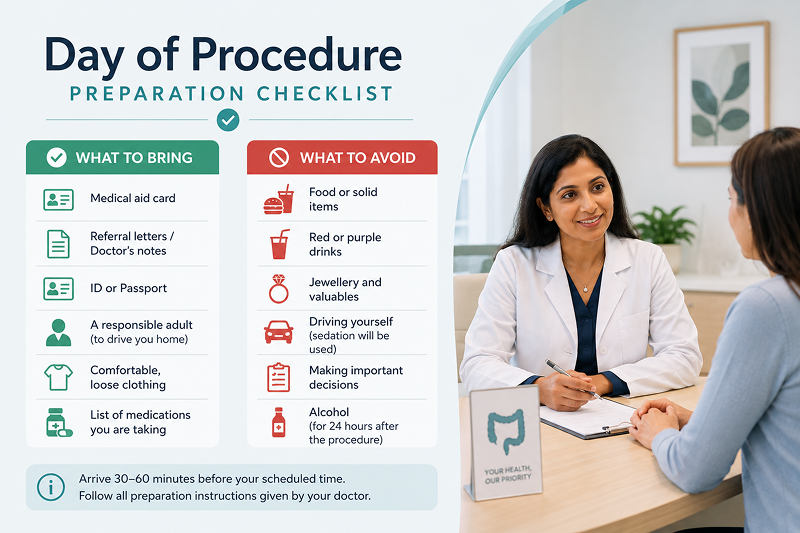
On the day of your procedure, you should:
- Arrive on time — usually 30–60 minutes before your scheduled procedure time
- Bring your medical aid card, any referral letters, and your ID
- Bring a responsible adult who can drive you home — you will not be able to drive after sedation
- Wear comfortable, loose clothing
- Leavejewelleryand valuables at home
Checking In and Pre-Procedure Assessment
When you arrive at Mediclinic Kloof, the nursing team will get you settled.A nurse will check your blood pressure,pulseand oxygen levels.You’llhave a brief discussion with Dr. Preetha Thomas before the procedure begins — this is the time to ask any last-minute questions.
You’llbe asked to change into a hospital gown and move to the procedure room when everything is ready.
Sedation: What You Need to Know
The colonoscopy is performed under sedation — not generalanaesthesia. This means you are in a light, twilight sleep: deeply relaxed and completely unaware of what is happening, butnot unconsciousin the way you would be for surgery. Most patients have no memory of the procedure at all.
The sedation is administered by injection before the procedure starts. It takes effect within minutes. Your oxygen levels and vital signs aremonitoredthroughout.
Source: American Society of Gastrointestinal Endoscopy (ASGE)
During the Colonoscopy: Step by Step
The procedure itself typically takes between 20 and 45 minutes, depending on what is found and whether any polyps need to be removed.
What the Doctor Does
You’lllie onyourleft sideonthe procedure table. The colonoscope is gently inserted into the rectum and slowly guided through the entire length of your colon. To improve visibility, a small amount of air or carbon dioxide is introduced into the colon — this may cause a sensation of pressure or bloating, though most patients on sedation are unaware of this.
Dr. Thomas carefully examines the lining of the colon as the scope is slowly withdrawn. It is during this withdrawal phase that most abnormalities are detected. If a polyp is found, it can usually be removedimmediatelyusing a small wire loop attached to the scope — a quick, painless procedure called a polypectomy.
Tissue samples (biopsies) may also be taken and sent to the laboratory for analysis. Youwon’tfeelthis.
Recovery After Your Colonoscopy
Once the procedure is complete,you’llbe moved to a recovery area where the nursing team willmonitoryou while the sedation wears off. This usually takes between 30 and 60 minutes.
Immediately After
- You may feel groggy, drowsy or a little disoriented — this is completely normal and expected
- You may experience some bloating or mild cramping from the air introduced during the procedure —this passesquickly
- You can eat and drink again once you feel ready — start with something light
- You will not be allowed to drive for theremainderof the day due to the sedation
The Rest of the Day
- Take it easy. Rest at home, avoid strenuous activity
- Light meals are recommended — nothing too heavy or spicy
- Avoid alcohol for 24 hours after your procedure
- Do not make important decisions or sign legal documents on the day of your procedure
Getting Your Results
Dr. Thomas will speak to youimmediatelyafter the procedure to tell you what was found.If a biopsy was taken, the results will typically come back within 7–10 working days, and you’ll receive a follow-up call or appointment to discuss them.
💡 QuickRecovery Guide: What’s Normal for 1–2 Days After
- Mild bloating or gas — normal, passes within a few hours
- Slight fatigue from the sedation — rest as needed
- Small amount of blood in the stool if a polyp was removed — usually minor and self-resolving
- Tenderness or fullness in the abdomen — normal
⚠️ Whento Call Your Doctor After a Colonoscopy
- Heavy rectal bleeding (more than a tablespoon) or persistent bleeding
- Severe abdominal pain or cramping thatdoesn’timprove
- Fever above 38°C
- Vomiting that persists after the day of the procedure
- Inability to pass gas or have a bowel movement after 2–3 days
If you experience any of the above after your procedure, contact our practiceimmediatelyon012 367 4504or go to your nearest emergency room.
What Your Results Mean
Most colonoscopies come back completely normal — and that is a result in itself.If something is found, here is what it typically means:
| Finding | What It Means |
| Polyps (removed during procedure) | Sent tolab. Most are benign (non-cancerous) adenomas. Results in 7–10 days.Follow-up timeline depends on size and type. |
| Polyps (too large to remove) | A second procedure or surgical referral may be needed. |
| Inflammation (colitis signs) | Further investigation andpossible biopsiestodeterminecause. Could indicate IBD, infection, orischaemia. |
| Diverticulosis | Small pouches in the colon wall.Very commonand usually managed with dietary changes. |
| Cancer suspected | Biopsy taken and sent to pathology. Dr. Thomas will discussnextsteps with you directly. You are not alone in this. |
| Normal findings | No actionneeded. Follow-up colonoscopy typically in 10 years (average risk). |
Related Reading
If your colonoscopy results touch on related conditions, you may find these helpful:
- Fatty Liver Disease: Early Warning Signs— early detection matters
- GERD vs Acid Reflux: Understanding the Difference— if heartburn or reflux symptoms are present
- Meet Dr. Preetha Thomas— your gastroenterologist at Mediclinic Kloof, Pretoria
- All Procedures Offered— gastroscopy, colonoscopy, endoscopic ultrasound, ERCP and more
Ready to Book Your Colonoscopy in Pretoria?
Dr. Preetha Thomas performs colonoscopies at Mediclinic Kloof,Erasmuskloof, Pretoria. She and her team will guide you
through every step — from your first consultation to full recovery.
Call us: 012 367 4504/5 dr.p.thomas01@gmail.com | Mon–Thu: 9am–5pm · Fri: 9am–1pm
Frequently Asked Questions About Colonoscopies in Pretoria
Below are the questions our patients most commonly ask. If you have a question thatisn’tcovered here, pleasedon’thesitate to contact us directly.
Is a colonoscopy painful?
No — not when done with sedation, which is the standard at our practice. You will be in a comfortable, drowsy state throughout and will have little to no memory of the procedure. Some patients experience mild bloating or cramping afterwards as the gas passes, but this resolves quickly. Most people are surprised by how straightforward it is.
How long does thewhole processtake, from arrival to going home?
Plan forapproximately 2–3 hours at the hospital, including check-in, preparation, the procedure itself (20–45 minutes), and recovery time in the ward.You’llneed someone to driveyouhome, and you should rest for theremainderof the day.
Will I be awake during the colonoscopy?
No. The procedure is performed under conscious sedation — a safe, light form of sedation that puts you in a deeply relaxed twilight state. You will not be awake or aware of the procedure. It is different from generalanaesthesia, which means recovery is faster and simpler.You’llfeel comfortablethroughout.
How far in advance do I need to prepare? When does the prep start?
Your dietary changes begin 3–5 days before the procedure (low-fibrediet). The day before,you’llbe on a clear liquid diet and will take your prescribed bowel prep solution. Your gastroenterologist will give you a specific prep schedule tailored to your procedure time. Following it exactly makes a significant difference to the quality of the examination.
Is a colonoscopy the same as a gastroscopy?
No. A colonoscopy examines the large intestine (colon and rectum). A gastroscopy (upper endoscopy) examines theoesophagus,stomachand upper part of the small intestine. Depending on your symptoms, your gastroenterologist may recommend one or both. In some cases, both procedures can be performed on the same day.
What happens if a polyp is found?
If a polyp is discovered during your colonoscopy, Dr. Thomas will remove it during the same procedure — youwon’tneed to come back for a second session just for that. The removed tissue is sent to a pathology lab for analysis. Most polyps arebenign, butremoving them prevents the small risk of them becoming cancerous over time.You’llreceive results within 7–10 working days.
Does medical aid cover a colonoscopy in South Africa?
Most South African medical aids cover colonoscopies, particularly when they are medicallyindicated(i.e.your doctor has referred you due to symptoms or family history). Screening colonoscopies may have different cover levels depending on your plan. We recommend checking with your medical aid in advance. Our receptionist team is happy toassistwith pre-authorisation— call us on 012 367 4504.
How often do I need a colonoscopy?
If your colonoscopy is normal and you are at average risk, a repeat is typically recommended every 10 years from age 45. If polyps are found, the follow-up schedule depends on the number,sizeand type of polyps. If you have a family history of colorectal cancer or inflammatory bowel disease, your gastroenterologist will recommend a more frequent schedulepersonalisedto your risk profile.