


You’ve had a scratchy throat for months. Maybe a cough that won’t fully go away, or a voice that sounds a little rougher than it used to. You’ve been to a GP, maybe an ENT, tried allergy medication, cut out dairy just in case. Nothing quite fixes it. If heartburn has never been part of the picture, reflux probably hasn’t crossed your mind as the cause. That’s exactly the trap silent reflux sets.
Silent reflux, known medically as laryngopharyngeal reflux, is a form of acid reflux that skips the burning chest sensation most people associate with GERD entirely. Instead, it shows up in the throat and voice box, which is precisely why it gets missed, misdiagnosed, or chalked up to allergies for months or years at a time.
If you’re new to the topic, our earlier piece on silent reflux and why it’s so often missed is a good starting point alongside this deeper look at the symptoms themselves.
What Is Laryngopharyngeal Reflux?
Laryngopharyngeal reflux, or LPR, happens when stomach contents travel past the esophagus entirely and reach the throat (pharynx) and voice box (larynx).
In typical GERD, the lower esophageal sphincter, the muscle at the bottom of the esophagus, is the one that malfunctions, letting acid rise partway up.
In LPR, it’s the upper esophageal sphincter, the muscle at the very top, that doesn’t close properly, allowing reflux to travel all the way to tissue that’s far more sensitive to acid exposure than the esophagus is.
That sensitivity difference matters. The esophagus has some natural resistance to acid. The throat and larynx don’t, which is why even small amounts of reflux reaching that high can cause outsized irritation, without ever producing the burning sensation that would tip someone off that reflux is the cause.
According to Cleveland Clinic, healthcare providers estimate that more than half of people who complain of chronic hoarseness actually have laryngopharyngeal reflux, and roughly 10% of people who visit a throat specialist end up diagnosed with it.
That’s a significant number of people cycling through ENT visits before reflux gets named as the underlying cause.
Silent Reflux vs. GERD: Key Differences
The two conditions overlap in cause, both involve stomach contents moving where they shouldn’t, but they diverge sharply in presentation, which is exactly what makes silent reflux so easy to miss.
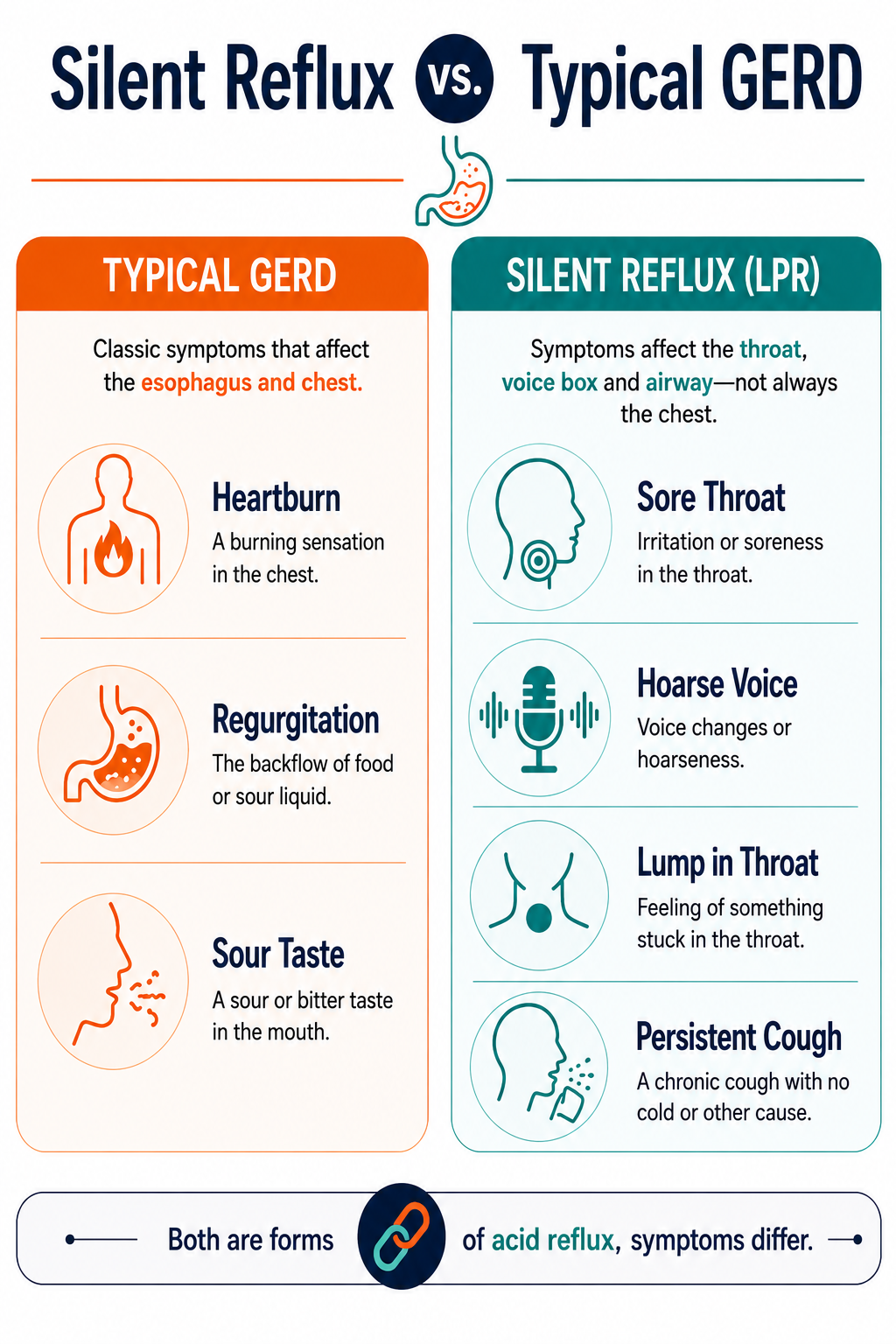
GERD typically involves the lower esophagus. The hallmark symptom is heartburn, a burning sensation behind the breastbone, often accompanied by regurgitation, chest discomfort, or a sour taste after meals. Most people, and most doctors, recognize this pattern immediately.
Silent reflux (LPR) typically involves the throat and larynx, well above where GERD symptoms usually show up. It rarely produces heartburn at all.
Atypical acid-reflux-related symptoms such as chest pain, globus sensation, chronic cough, and asthma can occur even in the presence of significant reflux, without the classic heartburn and regurgitation most people expect.
Some people have both conditions together. Others have LPR entirely on its own, with completely normal esophageal symptoms and no burning at all, which is precisely why it’s sometimes missed even during a workup for GERD versus acid reflux if the clinician is only looking for the classic pattern.
Silent Acid Reflux Signs You Might Be Missing
Because silent reflux doesn’t announce itself the obvious way, most people experiencing it don’t connect the dots. These are the signs worth paying attention to.
Chronic cough. Often dry, persistent, and worse in the morning or after meals. This is one of the most commonly reported LPR symptoms and one of the most frequently misattributed to allergies or a lingering cold.
Hoarseness or voice changes. A rougher, lower, or more strained voice than usual, sometimes worse earlier in the day and improving somewhat as the day goes on.
Globus sensation. The persistent feeling of a lump in the throat, even though nothing is actually there. This particular symptom sends a lot of people to an ENT before anyone considers reflux.
Frequent throat clearing. A near-constant urge to clear your throat, often without much actually coming up.
Excess mucus or phlegm. A feeling of thick mucus sitting at the back of the throat that won’t fully clear.
Chronic sore throat. Not tied to a cold or infection, and not responding to the usual remedies.
Difficulty swallowing. A sensation that food or liquid isn’t going down smoothly, distinct from actual pain when swallowing.
Postnasal Drip vs. Reflux: How to Tell Them Apart
This is probably the single most common misdiagnosis pathway for silent reflux, and it’s worth its own section because the symptom overlap is genuinely significant.
Both postnasal drip and LPR can cause throat clearing, a mucus-in-the-throat sensation, and a mild cough, which is exactly why so many people with silent reflux spend months on allergy medication before anyone reconsiders the diagnosis.
A few distinguishing clues help separate the two. Postnasal drip usually comes with other allergy or sinus symptoms: nasal congestion, sneezing, itchy eyes, or a runny nose, especially if it’s seasonal or tied to specific triggers like pollen or dust.
Silent reflux symptoms, by contrast, are often worse after eating, worse when lying down, or worse in the morning after a night spent horizontal, patterns that point toward digestive rather than sinus origin.
A bitter or sour taste at the back of the throat, particularly upon waking, leans toward reflux rather than allergies. And if antihistamines or nasal sprays haven’t made a dent in the symptoms despite a proper trial, that’s a reasonable signal to look elsewhere.
Neither test is perfect on its own, but the pattern matters more than any single symptom. If allergy treatment has been tried in good faith and nothing’s improved, silent reflux deserves a real look.
Common Misconceptions About Silent Reflux
A few widely held assumptions about silent reflux tend to delay proper diagnosis, and they’re worth addressing directly.
“No heartburn means it’s not reflux.” This is the single biggest misconception, and it’s precisely what gives silent reflux its name. Multiple sources note that only about a third of patients suspected of having LPR actually experience classic heartburn or regurgitation. The absence of heartburn doesn’t rule reflux out; for LPR specifically, it’s closer to the norm.
“It’s just allergies, so antihistamines should help eventually.” Allergy medication targets histamine response, not acid exposure. If symptoms haven’t budged after a proper trial, that’s meaningful information, not a sign to try harder with the same approach.
“If an endoscopy is normal, reflux isn’t the cause.” Standard upper endoscopy looks at the esophagus and stomach. LPR symptoms originate in the throat and larynx, tissue that a standard endoscopy doesn’t typically examine closely. A normal endoscopy result doesn’t rule out LPR at all.
“Reflux only happens after big or late meals.” While large or late meals are common triggers, LPR can occur with smaller reflux events that never produce a noticeable sensation in the esophagus, which is part of why symptom tracking around meals and sleep position tends to be more revealing than trying to recall one specific trigger meal.
What Causes Silent Reflux?
Silent reflux causes overlap heavily with standard GERD triggers, but a few factors are worth calling out specifically since LPR often responds to slightly different pressure points than typical reflux does.
Diet plays a significant role: caffeine, alcohol, citrus, spicy food, chocolate, and carbonated drinks can all provoke reflux that reaches high enough to cause throat symptoms.
Eating large meals or eating close to bedtime increases the likelihood of reflux reaching the throat overnight, since lying down removes gravity’s usual assistance in keeping stomach contents down.
Weight is a factor too, since excess abdominal pressure makes reflux, including the kind that reaches the throat, more likely. Smoking relaxes both esophageal sphincters, which raises the risk for LPR specifically as much as it does standard GERD.
And chronic throat clearing itself, ironically, can become part of the problem, since the repetitive mechanical irritation from clearing your throat can aggravate already-sensitive laryngeal tissue, creating a cycle that’s hard to break without addressing the underlying reflux.
Stress is another contributor that’s easy to overlook. It doesn’t cause reflux directly, but it can heighten sensitivity to the acid that’s already reaching the throat, which is part of why symptoms sometimes feel disproportionately worse during particularly demanding periods even when eating habits haven’t changed.
Certain medications, including some blood pressure drugs and muscle relaxants, can also relax the sphincters involved, so it’s worth mentioning current medications when discussing persistent throat symptoms with a doctor rather than assuming diet is the only variable at play.
How Silent Reflux Is Diagnosed
Diagnosing LPR is genuinely trickier than diagnosing typical GERD, partly because standard endoscopy, which looks at the esophagus, often comes back completely normal in people with silent reflux, since the problem tissue is higher up in the throat rather than in the esophagus itself.
An ENT evaluation is usually the starting point, involving a flexible laryngoscopy, a quick scope that lets a doctor see the back of the throat and voice box directly, looking for swelling, redness, or irritation consistent with reflux exposure. Symptom questionnaires are often used alongside the exam, since the pattern of symptoms carries real diagnostic weight here.
For a more definitive answer, esophageal pH monitoring can measure how far up acid is actually traveling, and specialized pharyngeal pH probes exist specifically to detect reflux reaching the throat, which standard esophageal pH testing can sometimes miss.
According to the NIH’s StatPearls overview of laryngopharyngeal reflux, diagnosis often relies on clinical assessment supported by laryngoscopic findings, since GERD and LPR frequently get confused and conflated despite representing two distinct conditions with different management approaches.
Silent Reflux Treatment and Diet
Treatment for silent reflux follows a similar overall approach to GERD, but often needs to be applied more strictly, since laryngeal tissue is more sensitive and takes longer to heal than the esophagus does.
Dietary changes form the foundation: reducing or eliminating caffeine, alcohol, citrus, spicy food, chocolate, and carbonated drinks, since these are the most consistently reported LPR triggers.
Smaller, more frequent meals reduce the pressure and volume available to reflux upward, and finishing eating at least three hours before lying down gives gravity time to do its job before you’re horizontal.
Lifestyle changes matter just as much. Elevating the head of the bed, rather than just stacking pillows, helps keep reflux from reaching the throat overnight. Weight management, where relevant, reduces abdominal pressure. Quitting smoking removes one of the more direct contributors to sphincter dysfunction.
On the medication side, proton pump inhibitors are commonly prescribed, though they sometimes take longer to show benefit for LPR than for typical GERD, since laryngeal tissue heals more slowly than esophageal tissue.
Some patients need a longer treatment trial, often eight to twelve weeks or more, before symptoms meaningfully improve, which is worth knowing upfront so the process doesn’t feel like it’s failing simply because relief isn’t immediate.
Silent Reflux in Babies and Children
LPR presents differently, and can be harder to spot, in infants and young children, since they can’t describe a lump-in-the-throat sensation or a sour taste the way an adult can.
Watch for frequent spitting up or vomiting beyond what’s typical, a chronic cough, noisy or raspy breathing, feeding difficulties or apparent discomfort during feeds, and recurrent respiratory issues like croup or wheezing that don’t have another clear explanation.
Some infants arch their backs or seem unusually fussy during or after feeding, which can be an early clue.
If you’re noticing a pattern of unexplained respiratory symptoms alongside feeding issues, it’s worth reading more on how to identify and manage digestive issues in children, since reflux in kids often needs a different diagnostic and treatment approach than the adult version.
Tracking Your Symptoms Before Your Appointment
Because silent reflux doesn’t leave the obvious clue that heartburn does, a symptom diary kept for a week or two before seeing a doctor can genuinely speed up diagnosis.
Note when throat symptoms flare, what you ate beforehand, how soon after eating you noticed anything, and whether symptoms are worse at certain times of day, particularly mornings, which often point toward overnight reflux.
It’s also worth noting sleep position, since people who sleep flat tend to report worse morning symptoms than those who sleep with the head slightly elevated. Any pattern connecting symptoms to specific foods, like citrus, coffee, or a late dinner, is worth writing down even if it seems minor at the time.
These details won’t replace a proper diagnostic workup, but they give a doctor a genuinely useful starting point rather than a vague description of “my throat’s been off for a while,” which is often all people can offer without having tracked anything in advance.
When to See a Doctor
Persistent throat symptoms lasting more than a few weeks, especially ones that haven’t responded to allergy treatment or standard cold remedies, are worth a proper evaluation rather than continued guessing.
This is particularly true if you’re also noticing voice changes that persist, a chronic cough with no clear respiratory cause, or ongoing globus sensation that’s starting to affect daily life.
Left unaddressed, chronic silent reflux can lead to longer-term complications: laryngeal inflammation, vocal cord changes, and in some cases, contribution to conditions like asthma that seem unrelated to digestion at first glance.
Getting a clear diagnosis early tends to mean a shorter, simpler treatment path than waiting until symptoms have been present for years.
Book a Consultation with Dr Preetha Thomas
If you’ve been dealing with a chronic cough, hoarseness, or that persistent lump-in-the-throat feeling without any clear answers, it might be time to consider reflux as the cause rather than continuing down the allergy or ENT-only route alone.
Dr Preetha Thomas, a gastroenterologist in Pretoria, can help investigate whether silent reflux is behind your symptoms and build a treatment plan suited to your case. Get in touch to book a consultation.
Frequently Asked Questions
What does silent reflux feel like?
Often a persistent throat irritation rather than heartburn: a lump-in-the-throat sensation, chronic throat clearing, hoarseness, or a dry cough. Many people never experience the classic burning chest sensation at all.
Is silent reflux worse at night?
Often, yes. Lying down removes gravity’s help in keeping stomach contents down, which is why symptoms like morning hoarseness or a bitter taste on waking are common patterns.
Can silent reflux cause a lump in the throat feeling?
Yes, this is one of the most frequently reported symptoms, known clinically as globus sensation, and it’s often what prompts people to see an ENT in the first place.
How long does silent reflux take to heal?
It varies, but laryngeal tissue generally heals more slowly than the esophagus. Many people need eight to twelve weeks of consistent treatment, sometimes longer, before symptoms meaningfully improve.
Disclaimer: This article is intended for general informational and educational purposes only. It does not constitute medical advice and should not be used to diagnose, treat, or manage any health condition. Every patient’s situation is different, and preparation, risks, and outcomes discussed here may not apply to your specific case. Please consult Dr. Preetha Thomas or another qualified gastroenterologist before making any decisions about your care, including whether an endoscopic ultrasound is appropriate for you