


Your Gut at 50: The Changes Nobody Warns You About
You hit your 50s and something shifts. Not dramatically — not all at once. But gradually, the digestive system you’ve relied on for decades starts behaving a little differently. Foods that never bothered you before now cause bloating. You’re more constipated than you used to be, or the opposite. Heartburn has become a nightly companion. And the bathroom schedule you once took for granted now feels unpredictable.
Here’s the honest truth: some of these changes are a completely normal part of ageing. But others are not. And one of the most important things you can do for your long-term health — starting at 50 — is learn to tell the difference.
In this guide, Dr. Preetha Thomas, specialist gastroenterologist at Mediclinic Kloof in Pretoria, walks you through exactly what happens to your digestive system as you age, which symptoms deserve medical attention, and what routine screening can save your life.
More than 60% of adults over 50 experience at least one significant gastrointestinal symptom — yet fewer than half seek specialist advice.
Source: World Gastroenterology Organisation (WGO)
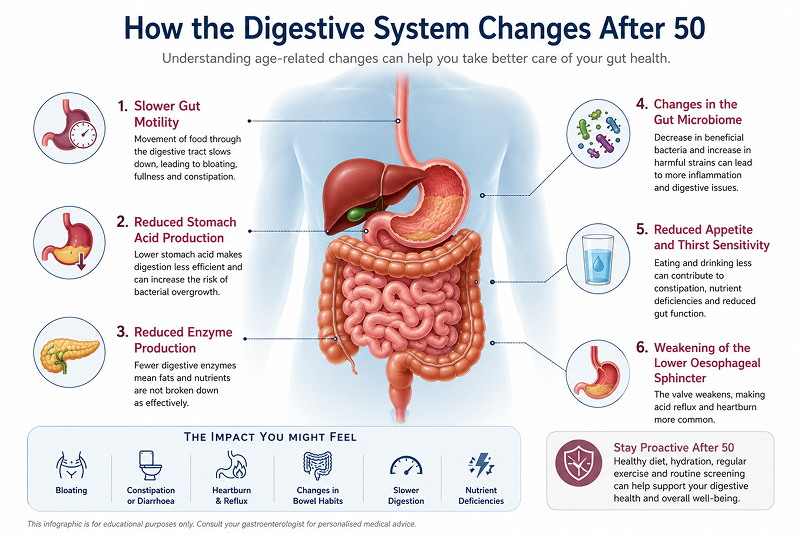
How Your Digestive System Changes After 50
The digestive system ages like every other organ in the body. The changes are gradual and not always obvious — but they are real, and they have practical consequences for how you feel every day.
Slower Gut Motility
One of the most universal changes after 50 is a slowing of gut motility — the speed at which food moves through your digestive tract. The muscles in the oesophagus, stomach and intestines become less efficient over time, and the nerve signals that coordinate movement become less precise. The result? Food takes longer to move from your stomach into the small intestine, and longer again to move through the colon. This contributes to the bloating, fullness and constipation that many over-50s experience.
Reduced Stomach Acid Production
After 50, the stomach lining gradually produces less hydrochloric acid — a condition called hypochlorhydria. Stomach acid plays a critical role in breaking down protein, absorbing minerals like calcium and iron, and killing harmful bacteria before they reach the intestines. Less stomach acid means slower, less efficient digestion — and in some cases, a greater risk of bacterial overgrowth in the small intestine (SIBO), which can cause bloating, gas and malabsorption.
Reduced Enzyme Production
The pancreas and small intestine produce digestive enzymes that break down fats, carbohydrates and proteins. After 50, enzyme output begins to decline — meaning fats in particular are less efficiently digested. This can contribute to post-meal discomfort, loose stools and nutrient malabsorption, particularly of fat-soluble vitamins like A, D, E and K.
Changes in the Gut Microbiome
The gut microbiome — the trillions of bacteria, viruses and fungi living in your intestines — changes significantly with age. After 50, there tends to be a decline in beneficial bacteria (like Lactobacillus and Bifidobacterium) and an increase in less beneficial strains. This microbiome shift is linked to increased inflammation, reduced immune function, slower gut motility, and a higher risk of conditions like C. difficile infection.
Reduced Appetite and Thirst Sensitivity
Many people over 50 notice a reduced sense of hunger and thirst. This is partly driven by hormonal changes and changes in the hypothalamus. The practical effect is that older adults often eat and drink less than they need to — contributing to constipation, nutrient deficiencies and reduced gut function overall.
Weakening of the Lower Oesophageal Sphincter
The valve between the oesophagus and stomach (the lower oesophageal sphincter, or LOS) tends to weaken with age. When this valve doesn’t close properly, stomach acid can reflux back into the oesophagus. This is why acid reflux and GERD become significantly more common after 50, even in people who rarely experienced it in younger years.
Common Digestive Symptoms After 50 — Normal vs. Not Normal
Not every new symptom is cause for alarm. But not every new symptom should be dismissed as “just getting older” either. Here’s how to think about the most common complaints:
| Symptom | Likely Normal (Age-Related) | Needs Medical Assessment |
|---|---|---|
| Constipation | Occasional, resolves with hydration and fibre | Persistent, new-onset, or alternating with diarrhoea |
| Heartburn / Reflux | Mild, occasional after heavy meals | Frequent (2x+/week), not responding to antacids |
| Bloating | Mild post-meal, resolves within hours | Daily, severe, or with pain or weight loss |
| Change in stool | Slightly slower transit, firmer stools | Narrowing, blood, mucus, or black/tarry appearance |
| Abdominal pain | Occasional cramping linked to diet or stress | Persistent, waking you at night, or worsening |
| Nausea | Occasional, linked to specific foods | Frequent, unexplained, or with vomiting |
| Weight loss | Intentional with lifestyle changes | Unintentional — even 3–5 kg without trying |
Conditions That Become More Common After 50
After 50, the risk of several serious gastrointestinal conditions increases significantly. Awareness is your best defence.
Colorectal Cancer
Colorectal cancer is one of the most common and most preventable cancers in South Africa — but only when caught early. The risk rises sharply after 50. Most colorectal cancers develop from small, non-cancerous polyps that grow slowly over 10 to 15 years. A colonoscopy can detect and remove these polyps before they become cancerous. When colorectal cancer is found at an early stage, the 5-year survival rate exceeds 90%. Caught late, that number drops dramatically.
The risk of colorectal cancer doubles every decade after age 40. Over 90% of cases are diagnosed in people over 50.
Source: American Cancer Society / Cancer Association of South Africa (CANSA)
Gastro-Oesophageal Reflux Disease (GERD) and Barrett’s Oesophagus
As the lower oesophageal sphincter weakens with age, GERD becomes increasingly common. Left untreated for years, chronic acid exposure can cause Barrett’s oesophagus — a precancerous change in the lining of the oesophagus that increases the risk of oesophageal cancer. A gastroscopy (upper endoscopy) can screen for this condition. Read more: GERD vs Acid Reflux — Understanding the Difference.
Diverticular Disease
Diverticulosis — the formation of small pouches in the wall of the colon — becomes very common after 50. It affects an estimated 50% of people over 60. For most people, it causes no symptoms and requires only dietary management. However, when these pouches become infected or inflamed (diverticulitis), it can cause severe abdominal pain, fever and bowel changes that require urgent treatment.
Fatty Liver Disease (NAFLD)
Non-alcoholic fatty liver disease is increasingly common after 50, particularly in patients with type 2 diabetes, obesity or metabolic syndrome. It is often silent in the early stages, but can progress to fibrosis, cirrhosis and liver failure if untreated. Early symptoms of fatty liver disease are subtle — which is why routine assessment after 50 matters.
IBS — New Onset After 50
While IBS is commonly associated with younger adults, new-onset bowel symptoms after 50 should never be automatically labelled IBS without proper investigation. Symptoms that mimic IBS — cramping, loose stools, bloating — can also be early signs of bowel cancer, IBD, or coeliac disease. Read: IBS symptoms you should not ignore.
Coeliac Disease — Late Diagnosis
Many people are diagnosed with coeliac disease for the first time in their 50s and 60s. The condition is often masked for decades by vague symptoms like fatigue, mild bloating and anaemia. A blood test and gastroscopy can confirm the diagnosis. Once diagnosed, a strict gluten-free diet prevents long-term complications including intestinal damage and lymphoma.
 Red Flag Symptoms After 50 — See a Gastroenterologist Urgently
- Blood in the stool — bright red or dark/tarry (bleeding anywhere in the GI tract)
- Unexplained weight loss of 3–5 kg or more without dietary changes
- Persistent abdominal pain that does not resolve or wakes you at night
- Difficulty or pain when swallowing (dysphagia)
- Jaundice — yellowing of the skin or whites of the eyes
- New or persistent change in bowel habits lasting more than 4 weeks
- Vomiting blood or material that looks like coffee grounds
- Anaemia with no obvious explanation (fatigue, dizziness, pale skin)
These symptoms don’t always mean something serious — but they always need proper investigation. Contact Dr. Preetha Thomas’s practice in Pretoria as soon as possible if any of these apply to you.
Screening Recommendations for Over-50s
Prevention is always better than cure. These are the key screening tests recommended for digestive health after 50:
| Screening Test | What It Detects | Recommended From |
|---|---|---|
| Colonoscopy | Colorectal polyps, cancer, IBD, diverticulosis | Age 45 (average risk) / Age 40+ with family history |
| Gastroscopy | GERD, Barrett’s oesophagus, peptic ulcers, coeliac disease | When symptomatic, or as directed by specialist |
| Liver function tests | Fatty liver disease, hepatitis, liver inflammation | Annually from age 50 (especially with risk factors) |
| Faecal occult blood test | Hidden blood in stool — early colorectal cancer | Annually if colonoscopy not yet done |
| Abdominal ultrasound | Liver, gallbladder, spleen, kidneys and bile ducts | As directed; useful with metabolic risk factors |
| H. pylori test | Stomach bacteria linked to ulcers and gastric cancer | If symptomatic; especially if not previously tested |
7 Practical Tips for Better Digestive Health After 50
The right lifestyle choices make a significant difference to how your gut functions as you age. These are evidence-backed recommendations — not generic advice.
Increase Soluble Fibre — Not Just Any Fibre
Soluble fibre (found in oats, legumes, apples and psyllium husk) feeds beneficial gut bacteria and helps regulate bowel movements without irritating the bowel. After 50, aim for 25–30g of total fibre daily. Increase gradually to avoid gas and bloating.
Stay Hydrated — More Than You Think You Need To
Thirst sensitivity decreases with age, so you may not feel thirsty even when you’re dehydrated. Dehydration is one of the leading causes of constipation after 50. Aim for at least 1.5–2 litres of water daily, more if you’re active or in a warm climate.
Eat Smaller, More Frequent Meals
A slower stomach empties better with smaller portions. Large meals put more pressure on the lower oesophageal sphincter (contributing to reflux) and overwhelm digestive enzyme capacity. Spreading your food intake across 4–5 smaller meals supports better gut function.
Reduce Ultra-Processed Foods and Red Meat
Ultra-processed foods are linked to gut microbiome disruption, increased gut inflammation and higher colorectal cancer risk. After 50, prioritise whole foods, vegetables, fruits, legumes and lean proteins. Limit red and processed meat to less than 500g per week.
Move Every Day — Even a 30-Minute Walk
Physical activity stimulates gut motility — it literally helps food move through the digestive tract. Sedentary behaviour is one of the strongest risk factors for constipation, fatty liver disease and colorectal cancer. A brisk 30-minute walk daily makes a measurable difference.
Manage Stress Actively
The gut-brain connection becomes more pronounced with age. Chronic stress alters gut motility, worsens reflux, disrupts the microbiome and lowers the pain threshold for gut symptoms. Mindfulness, walking, proper sleep and social connection all protect gut health indirectly but meaningfully.
Review Your Medications With Your Doctor
Many commonly prescribed medications after 50 have significant gastrointestinal side effects. NSAIDs (ibuprofen, naproxen) damage the stomach lining and increase ulcer risk. Calcium channel blockers slow gut motility. Iron supplements cause constipation. Antibiotics disrupt the gut microbiome. Ask your doctor to review your full medication list with GI health in mind.
 Quick Checklist: Digestive Health After 50
- Have you had a colonoscopy? Book one if you’re 45+ and haven’t had one in the last 10 years
- Do you drink at least 1.5L of water daily?
- Are you eating 25–30g of fibre per day?
- Are you getting at least 30 minutes of physical activity most days?
- Have you had liver function tests in the last 2 years (especially if you have diabetes or metabolic syndrome)?
- Have you discussed any GI side effects of your current medications with your doctor?

Related Reading
Concerned About Your Digestive Health After 50?
Dr. Preetha Thomas is a specialist gastroenterologist at Mediclinic Kloof, Pretoria. Whether you need a colonoscopy screening, a second opinion, or a full digestive health assessment, her team is here to help.
Call us: 012 367 4504/5
dr.p.thomas01@gmail.com | Mon–Thu: 9am–5pm · Fri: 9am–1pm