

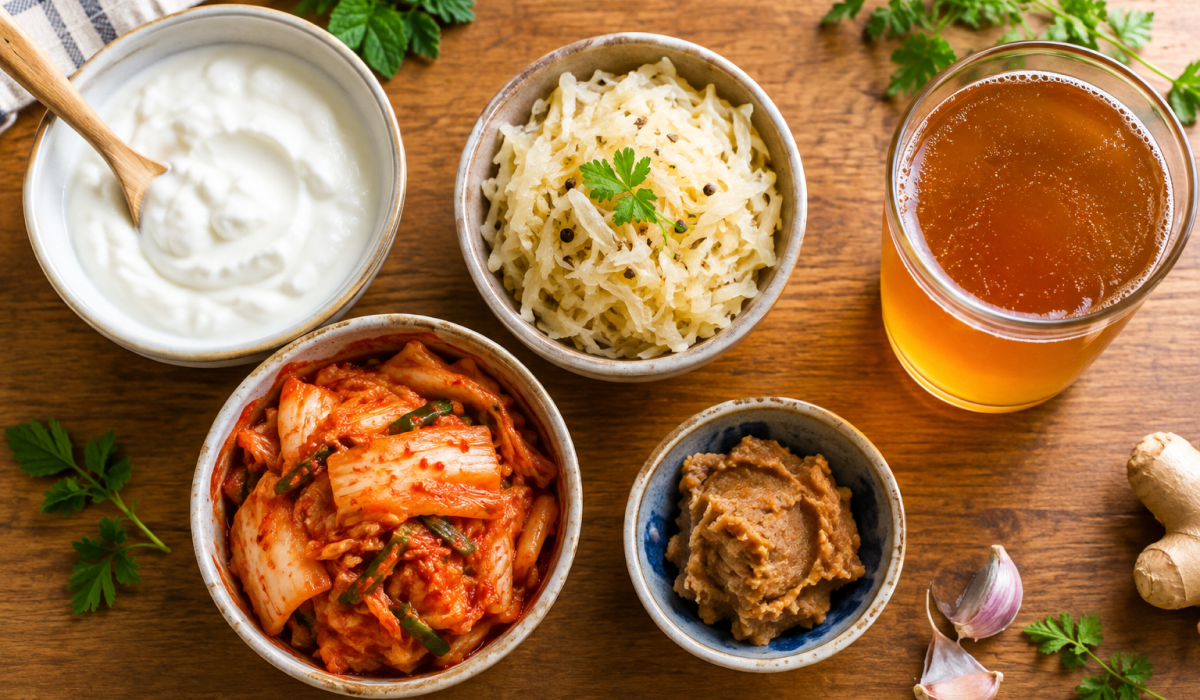
Someone’s told you to eat more fermented foods for your gut. Maybe a doctor, maybe a wellness account you follow, maybe just a friend who swears by their morning kefir. The advice is everywhere, but the specifics rarely are. Which foods actually count?
How much do you need? Is a daily yogurt doing anything, or do you need to be eating kimchi with every meal?
Fermented foods and gut health are genuinely connected, but the relationship is more nuanced than “eat this, feel better.”
This guide breaks down what fermented foods actually do, which ones are worth prioritizing, and how to fit them into your diet without overcomplicating things.
How Fermented Foods Support Gut Health
Fermentation is one of the oldest food preservation methods in existence, and it works by letting bacteria, yeast, or other microorganisms break down sugars and starches in food. In the process, many fermented foods end up containing live cultures, strains of bacteria like
Lactobacillus and Bifidobacterium, that can interact with the trillions of microorganisms already living in your gut. Fermentation also naturally produces digestive enzymes as part of the process, which is part of why fermented foods are often easier to digest than their unfermented counterparts.
This matters because your gut microbiome, the community of bacteria and other microbes in your digestive tract, plays a role in far more than digestion. It influences immune function, nutrient absorption, and increasingly, research points to connections with mood and cognitive health as well.
A more diverse, balanced microbiome is generally associated with better digestive comfort and overall health, and regularly eating fermented foods is one of the more accessible ways to support that diversity.
It’s worth being precise about the claim here. Fermented foods aren’t a cure for digestive conditions, and the science, while promising, is still developing in a lot of areas.
What’s reasonably well established is that many fermented foods introduce beneficial bacteria to your gut, and a gut with a more diverse bacterial population tends to function better overall.
Probiotics vs. Prebiotics: What’s the Difference?
This distinction trips a lot of people up, and it’s worth clearing up before going further, since the two terms get used almost interchangeably despite meaning different things.
Probiotics are live microorganisms, specific strains of bacteria or yeast, that can provide a health benefit when consumed.
According to Mayo Clinic, probiotics are naturally found in fermented foods such as yogurt and sauerkraut, and they help the body digest food or assist with symptoms of certain conditions.
Prebiotics, on the other hand, are types of fiber the body can’t digest itself, but which feed the beneficial bacteria already in your gut. Mayo Clinic notes that prebiotics are found mainly in high-fiber foods, and when probiotics and prebiotics are combined, the result is sometimes referred to as a synbiotic.
In practice, this means fermented foods (your probiotic source) work best alongside a diet that also includes plenty of fiber-rich foods like oats, bananas, and vegetables (your prebiotic source), since the prebiotics essentially feed and support the probiotics you’re introducing.
Our guide on foods that heal your gut covers this fiber side of the equation in more detail if you want to build out the full picture.
Best Fermented Foods for Gut Health
Not all fermented foods are created equal, and some are more consistently reliable sources of live cultures than others. Here’s where to start.
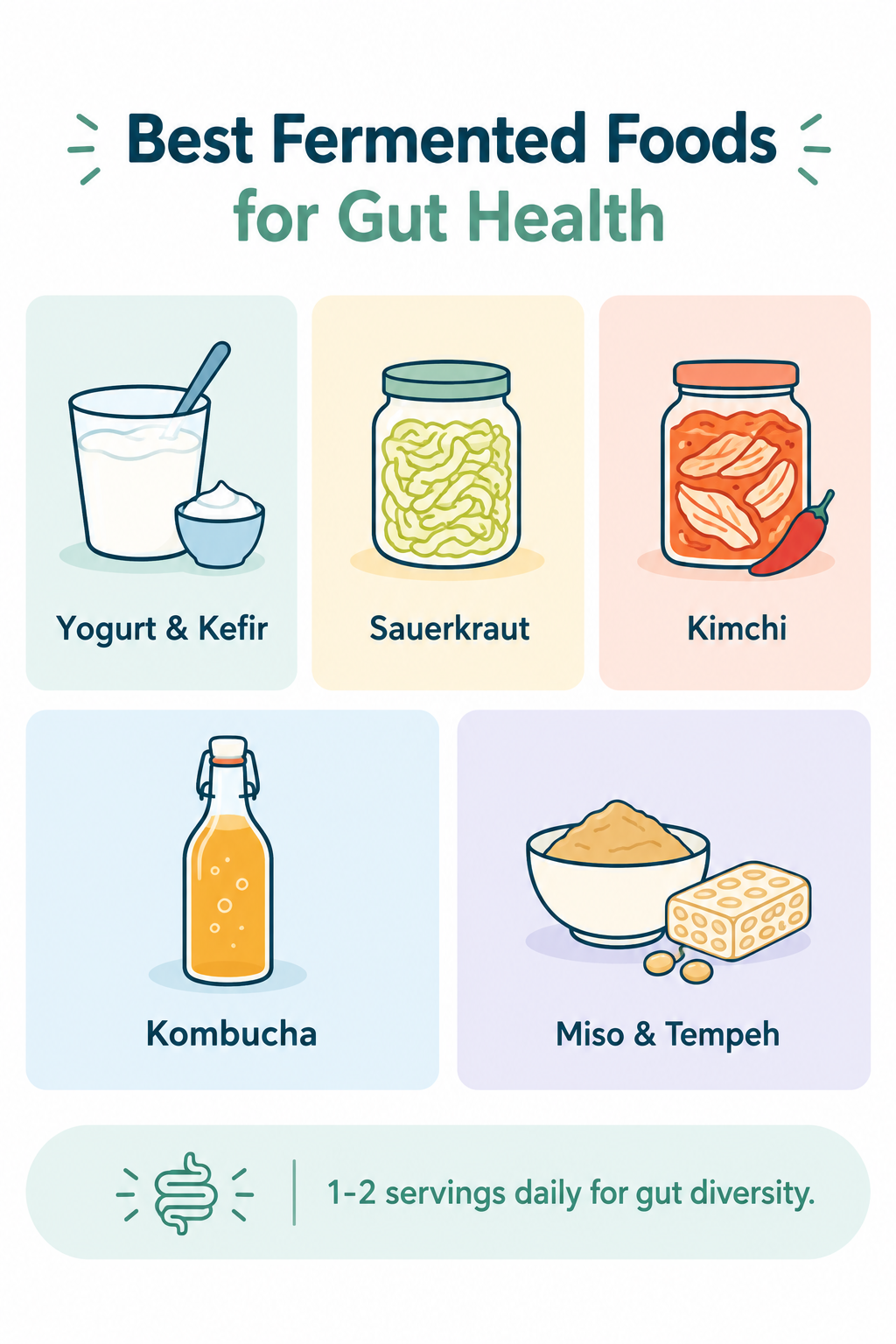
Yogurt and kefir. Probably the most accessible entry point, since both are widely available and generally well tolerated.
Look for labels that say “live and active cultures,” since some commercially processed yogurts are heat-treated after fermentation, which kills off the beneficial bacteria. Kefir tends to contain a broader variety of bacterial strains than yogurt and has a thinner, drinkable consistency.
Sauerkraut. Fermented cabbage, and one of the simplest ferments to make at home. Choose unpasteurized versions specifically, since pasteurization, like heat-treating yogurt, kills the live cultures that make sauerkraut useful for gut health in the first place.
Kimchi. A spicier, more complex cousin of sauerkraut, typically made with napa cabbage, radish, and a mix of seasonings. Beyond the probiotic content, kimchi also delivers a decent dose of vitamins and antioxidants from its vegetable base.
Kombucha. Fermented tea, lightly effervescent, with a tangy flavor profile. Worth checking sugar content on store-bought versions, since some brands add back a fair amount of sugar after fermentation to balance the tartness.
Miso and tempeh. Both fermented soy products, common in Japanese and Indonesian cooking respectively. Miso works well stirred into soups or dressings, while tempeh, with its firmer texture, holds up well as a meat substitute in stir-fries and similar dishes.
Variety matters more than volume here. Rotating through a few different fermented foods introduces a wider range of bacterial strains than eating a large amount of just one.
Fresh vs. Store-Bought: Does It Matter?
Not every product labeled “fermented” on a grocery shelf delivers the same gut benefits, and it’s worth knowing what to actually look for.
Pasteurization is the main thing to watch for. Many mass-market pickles, some sauerkraut, and certain kombucha brands are pasteurized after fermentation for shelf stability, a process that extends shelf life but also kills the live bacteria that made the food beneficial for gut health in the first place.
These products might still taste fermented, but they’re functionally no different from a regular pickled vegetable in terms of probiotic content.
Checking the label for phrases like “raw,” “unpasteurized,” or “contains live cultures” is the simplest way to confirm you’re getting an active product.
Refrigerated sections tend to house the unpasteurized versions more often than shelf-stable aisles, since live cultures generally need refrigeration to stay active and avoid over-fermenting.
Homemade ferments, when made safely, are another reliable way to guarantee live cultures, though they do require some attention to food safety practices to avoid contamination.
Fermented Foods for Bloating and Digestion
This is one of the more common reasons people turn to fermented foods in the first place, and the evidence, while not universal, is reasonably encouraging for certain situations.
Some research suggests that specific probiotic strains can help reduce bloating and general digestive discomfort, particularly in people whose symptoms are related to an imbalanced gut microbiome.
That said, responses vary significantly from person to person, and in some cases, introducing fermented foods too quickly can actually cause temporary bloating or gas as your gut adjusts to the new bacterial input, which is worth knowing upfront so it doesn’t feel like a setback.
It’s also worth being clear that fermented foods aren’t a universal fix for chronic bloating. If bloating is persistent, severe, or tied to a broader pattern of digestive symptoms, it’s worth looking at the bigger picture rather than expecting diet changes alone to resolve it.
Our post on following a low-FODMAP diet for IBS relief covers a more structured approach for situations where bloating is a recurring, significant issue rather than an occasional discomfort.
Fermented Foods vs. Probiotic Supplements
Both approaches have a place, but they’re not interchangeable, and it’s worth understanding the trade-offs before deciding which fits your situation.
Fermented foods offer a broader, more varied mix of bacterial strains than most supplements, plus additional nutritional benefits, vitamins, fiber, and in some cases protein, that a capsule doesn’t provide.
They’re also generally more affordable and easier to build into a normal diet without thinking of it as “taking a supplement.”
Probiotic supplements offer more consistency and precision. You know exactly which strains you’re getting and in what quantity, which matters for specific, targeted uses, such as counteracting the gut disruption caused by a course of antibiotics.
Our guide on minimizing antibiotic damage to your gut goes into more detail on when a targeted probiotic supplement makes more sense than relying on food sources alone.
According to the National Center for Complementary and Integrative Health (NCCIH), probiotics have shown promise for specific purposes such as preventing antibiotic-associated diarrhea, but a great deal remains unknown about whether they’re helpful for many other conditions, and the FDA doesn’t regulate probiotic supplements the way it does medications.
For general, everyday gut support, food sources are usually the more sensible default, reserving supplements for specific situations where a doctor has recommended a particular strain or dose.
If you’ve wondered whether the probiotic hype around supplements specifically is justified, our honest look at whether probiotics are worth it digs deeper into that exact question.
How Much Fermented Food Should You Eat Daily?
There’s no single official number, but a reasonable, well-supported target is one to two servings of fermented food daily, adjusted based on tolerance and variety.
A serving might look like a cup of yogurt or kefir, a small side of sauerkraut or kimchi (roughly two to three tablespoons), or a cup of kombucha.
Rather than eating the same fermented food every day, rotating between a few different options over the course of a week exposes your gut to a wider range of bacterial strains than sticking with just one.
If you’re new to fermented foods, starting small and building up gradually is worth doing. A sudden jump from none to several servings a day can cause temporary digestive discomfort simply because your gut needs time to adjust to the new bacterial input.
Are Fermented Foods Safe for Everyone?
For most people, fermented foods are safe and well tolerated, but a few groups should approach them with more caution.
People with histamine intolerance may find that fermented foods, which tend to be naturally higher in histamine, trigger symptoms like headaches, flushing, or digestive discomfort.
Anyone with a compromised immune system should talk to a doctor before significantly increasing intake of raw, unpasteurized fermented foods, since the live bacteria that make them beneficial for most people can pose a genuine risk in that specific situation.
And several fermented foods, particularly miso, kimchi, and some sauerkraut, carry a fair amount of sodium, worth factoring in for anyone managing blood pressure or sodium intake closely.
Introducing fermented foods gradually rather than all at once is a sensible approach for anyone, not just people in these higher-risk categories, since it gives your gut time to adjust and makes it easier to notice if a particular food doesn’t agree with you.
This same gradual approach applies when your routine changes suddenly, like international travel, where gut adjustment matters just as much. Our guide on preparing your gut before traveling covers how fermented foods and probiotics fit into that specific situation.
The Gut-Brain Connection
One of the more interesting threads in gut health research is the gut-brain axis, the communication network linking your digestive system and your brain.
This connection helps explain why digestive issues so often coincide with mood changes, and why stress can visibly affect digestion in return.
The exact mechanisms are still being actively researched, but a healthier, more diverse gut microbiome is increasingly associated with better mood regulation and cognitive function in the existing body of research.
This doesn’t mean eating more sauerkraut will fix anxiety or depression, that would be overstating a genuinely complex and still-developing area of science, but it does add another reasonable argument for treating gut health as connected to overall wellbeing rather than a purely digestive concern.
Easy Ways to Add Fermented Foods to Your Day
Fitting fermented foods into an existing routine doesn’t require restructuring every meal. A few simple swaps and additions make it manageable without turning it into a project.
Start the day with kefir instead of regular milk in a smoothie, or top morning oatmeal with a spoonful of yogurt. At lunch, a small side of sauerkraut or kimchi alongside a sandwich or grain bowl adds both flavor and probiotic content without needing a separate dish.
Miso works well whisked into a quick soup base or salad dressing, an easy way to fold it into dinner without changing the whole meal around it. Kombucha makes a reasonable swap for a sugary soda or juice when you want something with a bit of fizz.
The goal isn’t perfection or eating fermented food at every single meal. Building it into your routine a few times a week, in ways that fit naturally into what you’re already eating, tends to be far more sustainable than an all-or-nothing approach that fizzles out after a week or two.
How Long Before You Notice a Difference?
Patience matters here, since gut microbiome changes tend to happen gradually rather than overnight. Some people notice mild digestive changes, slightly improved regularity or less bloating, within a week or two of consistently adding fermented foods to their diet.
For more meaningful shifts in gut bacterial diversity, research generally points to a timeline of several weeks to a few months of consistent intake, rather than a handful of days.
It’s also worth setting realistic expectations. Fermented foods work best as part of an overall pattern, alongside adequate fiber, hydration, and general dietary quality, rather than as a single fix layered on top of an otherwise unchanged diet.
If you’ve been eating fermented foods consistently for a couple of months without noticing any change in symptoms you were hoping to address, that’s a reasonable point to consider whether something else might be driving the issue instead.
Frequently Asked Questions
Can fermented foods help with bloating?
For some people, yes, particularly when bloating is related to an imbalanced gut microbiome. Results vary by individual, and introducing fermented foods too quickly can temporarily cause bloating as your gut adjusts.
Are fermented foods good for IBS?
Some people with IBS report improvement with specific fermented foods or probiotic strains, but responses are highly individual, and certain fermented foods can actually trigger symptoms in people sensitive to specific ingredients. A structured approach, like a low-FODMAP diet, is often more reliable for managing IBS symptoms specifically.
Do fermented foods have side effects?
Mild bloating or gas during the adjustment period is common and usually temporary. People with histamine intolerance or compromised immune systems should be more cautious and talk to a doctor before significantly increasing intake.
Are fermented foods safe during pregnancy?
Most pasteurized fermented foods, including yogurt and kefir, are generally considered safe during pregnancy. Unpasteurized options carry a higher risk of harmful bacteria and are typically best avoided or discussed with a doctor first.
Talk to a Gastroenterologist About Your Gut Health
Fermented foods are a genuinely useful part of supporting your gut, but they’re not a substitute for addressing ongoing digestive symptoms that diet changes alone haven’t resolved. If bloating, irregular digestion, or other gut issues have been sticking around despite dietary adjustments, it’s worth getting a proper evaluation rather than continuing to experiment on your own.
Dr Preetha Thomas, a gastroenterologist in Pretoria, can help identify what’s actually driving your symptoms and build a plan that goes beyond general dietary advice. Get in touch to book a consultation and get a clearer picture of what your gut actually needs.
Disclaimer: This article is intended for general informational and educational purposes only. It does not constitute medical advice and should not be used to diagnose, treat, or manage any health condition. Every patient’s situation is different, and preparation, risks, and outcomes discussed here may not apply to your specific case. Please consult Dr. Preetha Thomas or another qualified gastroenterologist before making any decisions about your care, including whether an endoscopic ultrasound is appropriate for you