


Heartburn that won’t settle. Food that seems to stick on the way down. A burning, sour taste that comes back up after meals. If you’ve been living with symptoms like these, and the usual measures haven’t fixed them, it’s natural to wonder what’s actually going on inside your oesophagus.
That’s the question manometry and pH studies are designed to answer. They’re specialised diagnostic tests that let your doctor look beyond what you can describe and measure how your oesophagus is really working: how well the muscle squeezes, and how much acid is escaping from the stomach.
Instead of treating symptoms by trial and error, you get actual information to base treatment on.
This guide explains what the two tests are, when they’re used, how to prepare, what the experience is like, and what the results can and can’t tell you.
What Are Manometry and pH Studies?
Manometry and pH studies are two separate tests that are often done together, because they answer two different questions about the same organ.
The oesophagus is the muscular tube that carries food and liquid from your throat to your stomach.
It has to do two jobs well. It has to push what you swallow downwards in a coordinated wave, and it has to keep stomach contents from flowing back up, which depends on a valve at the bottom called the lower oesophageal sphincter. Manometry tests the first job, and pH monitoring tests the second.
What Is Esophageal Manometry?
Esophageal manometry is an esophageal motility test. It measures the pressure and coordination of the muscle contractions in your oesophagus as you swallow, as well as how well the lower sphincter opens and closes.
According to Mayo Clinic, the test involves placing a thin, pressure-sensitive tube through your nose and into your oesophagus to measure pressure as you swallow. A computer records the speed, strength, and pattern of each contraction.
The result is a detailed picture of how well your oesophagus moves food along, which is especially useful when swallowing is the main problem.
What Is Esophageal pH Monitoring?
Esophageal pH monitoring is a pH monitoring test that measures how often, and for how long, acid from the stomach flows back up into the oesophagus. Acid has a low pH, so a sensor sitting in the oesophagus can detect each time acid washes up and record how long it stays.
There are two common ways of doing this. One uses a thin catheter passed through the nose and left in place for about 24 hours.
The other uses a small wireless capsule attached to the oesophageal lining during an endoscopy, which records for a couple of days. In both cases, you keep a diary of your symptoms, meals, and sleep, so the recording can be matched to what you were feeling at the time.
Why Are These Tests Sometimes Performed Together?
Because symptoms like heartburn, regurgitation, and chest discomfort can have more than one cause, and they can overlap.
Someone with reflux symptoms might have a muscle problem, an acid problem, or both. Doing manometry and pH monitoring together, often in the same visit, gives a fuller picture.
It also has a practical benefit. Manometry shows exactly where the lower oesophageal sphincter sits, which helps position the pH sensor accurately. The American College of Gastroenterology notes that patients commonly have manometry just before a pH catheter is placed, which is why the fasting instructions for the two tests are so similar.
When Might You Need Manometry and pH Studies?
These tests aren’t the first thing most people have. Usually, a doctor starts with a conversation, a physical examination, and often an endoscopy to look at the lining. Manometry and pH studies come in when the answers aren’t clear, or when treatment hasn’t worked.
Persistent Heartburn and Acid Reflux
If you’ve had frequent heartburn for a long time, and especially if acid-reducing medication hasn’t helped, it can be hard to tell whether acid is really the problem. pH monitoring answers that directly.
It shows whether you have abnormal acid exposure, or whether your symptoms are caused by something else, such as a sensitive oesophagus or a muscle problem. Our guide on the difference between GERD and ordinary acid reflux explains when reflux becomes a condition that needs proper investigation.
Difficulty Swallowing Food or Liquids
Food sticking in the chest, taking much longer to eat, or struggling with both solids and liquids can point to a problem with how the oesophageal muscle moves. Manometry is the main test for this. If swallowing trouble is what’s brought you here, you may also find our article on managing difficulty swallowing useful.
Regurgitation and Chest Discomfort
Food or liquid coming back up into the throat, a sensation of pressure or burning behind the breastbone, or chest pain that isn’t from the heart can all have an oesophageal cause. Heart causes of chest pain always need to be ruled out first, but once they have been, these tests can help find the explanation.
Symptoms That Continue Despite Treatment
This is one of the most common reasons for referral. If you’ve tried lifestyle changes and medication for a reasonable period and symptoms continue, it’s time to stop guessing.
The tests can show whether acid is still reaching the oesophagus despite treatment, or whether the problem lies elsewhere. They’re also commonly used to assess the oesophagus before anti-reflux surgery, to make sure the muscle works well enough for the operation to be suitable.
How to Prepare for Manometry and pH Studies
Preparation is usually straightforward, but it’s important to follow the instructions you’re given, because they vary between tests, doctors, and individual circumstances.
Fasting. You’ll normally be asked not to eat or drink for several hours beforehand, often from midnight or for at least six hours, so your stomach is empty. Mayo Clinic notes that your stomach should be empty before manometry.
Medication. Tell your doctor about everything you take, including over-the-counter products and supplements. Some medicines can affect how the oesophagus moves or how much acid it’s exposed to. Your doctor may ask you to pause certain medicines, such as some acid-reducing tablets, muscle relaxants, or heart medicines, for a few days before the test. Whether to stop acid-reducing medication depends on whether the aim is to test with or without treatment, so please don’t stop anything on your own. Ask first.
Questions to confirm beforehand:
- Exactly when to stop eating and drinking
- Which medicines to take, pause, or avoid, and for how long
- Whether you’ll need someone to drive you home (usually not, because sedation isn’t used)
- How long the visit will take
- How and when you’ll get your results
If you have diabetes, let the rooms know, because fasting may affect your usual routine.
What Happens During the Tests?
Knowing what to expect takes a lot of the anxiety out of it. Both tests are done as outpatient procedures, usually without sedation, because you need to be awake and able to swallow normally.
The Esophageal Manometry Procedure
Your nostril is numbed with a gel or spray, and a thin, flexible tube is gently passed through your nose and down into your oesophagus and stomach. You’ll be asked to sip water to help it pass, which can trigger a gagging sensation for a moment.
Once it’s in place, you’ll either sit up or lie back, and you’ll be asked to swallow small sips of water on request, usually around ten times. Sensors along the tube record how your oesophageal muscle responds to each swallow. You’ll be asked to stay still and breathe slowly, and then the tube is removed.
The pH Monitoring Procedure
With the catheter method, a thin tube with a sensor at the tip is passed through the nose, positioned in the lower oesophagus, and taped to your nose or cheek.
The other end connects to a small recorder you wear on a strap, and you go about your day for around 24 hours, eating normally and keeping a diary of symptoms, meals, and lying-down times.
With the capsule method, a tiny capsule is attached to the oesophageal lining during an endoscopy and sends readings to a receiver you carry. It typically records for a couple of days, and the capsule falls off by itself and passes naturally.
Does the Testing Cause Discomfort?
It’s fair to say the tests aren’t pleasant, but they aren’t usually painful either. Common effects include gagging when the tube goes in, watery eyes, and a sore or irritated nose or throat for a short while afterwards. Mild nosebleeds are uncommon, and serious complications are rare.
During a 24-hour catheter study, many people find the tube a nuisance, a bit like having something stuck in the nose. Most people tolerate it well, and it can help to remember that it’s short-term and gives your doctor genuinely useful information.
How Long Do the Tests Take?
Manometry itself usually takes around half an hour to an hour, including preparation. pH monitoring takes longer in terms of recording time, usually about 24 hours with a catheter, or around two to four days with a wireless capsule, though you spend only a short time at the clinic for placement. Your doctor’s rooms will give you exact timings.
What Can Manometry and pH Studies Diagnose?
These tests don’t diagnose every digestive problem, but they’re very good at answering particular questions. Depending on the results, they can help evaluate:
- Oesophageal motility disorders, where the muscle is too weak, too forceful, or poorly coordinated
- Achalasia and certain swallowing disorders, in which the lower sphincter fails to relax properly and food struggles to pass into the stomach
- Gastro-oesophageal reflux disease (GERD), by showing how much acid reaches the oesophagus, which is why these are considered key GERD diagnostic tests
- Abnormal oesophageal acid exposure, including whether symptoms line up with reflux episodes
- Persistent symptoms where the diagnosis remains unclear, by helping to confirm or rule out a cause
Manometry can also point toward a hiatal hernia, where part of the stomach slides up through the diaphragm, which is a common contributor to reflux and swallowing trouble.
Sometimes the most valuable result is a negative one. If acid exposure is normal and the muscle works well, that points your doctor toward other explanations, and it can save you from years of unnecessary acid-suppressing treatment.
Manometry vs. pH Monitoring: What Is the Difference?
Because the two tests are so often mentioned together, it helps to see them side by side.
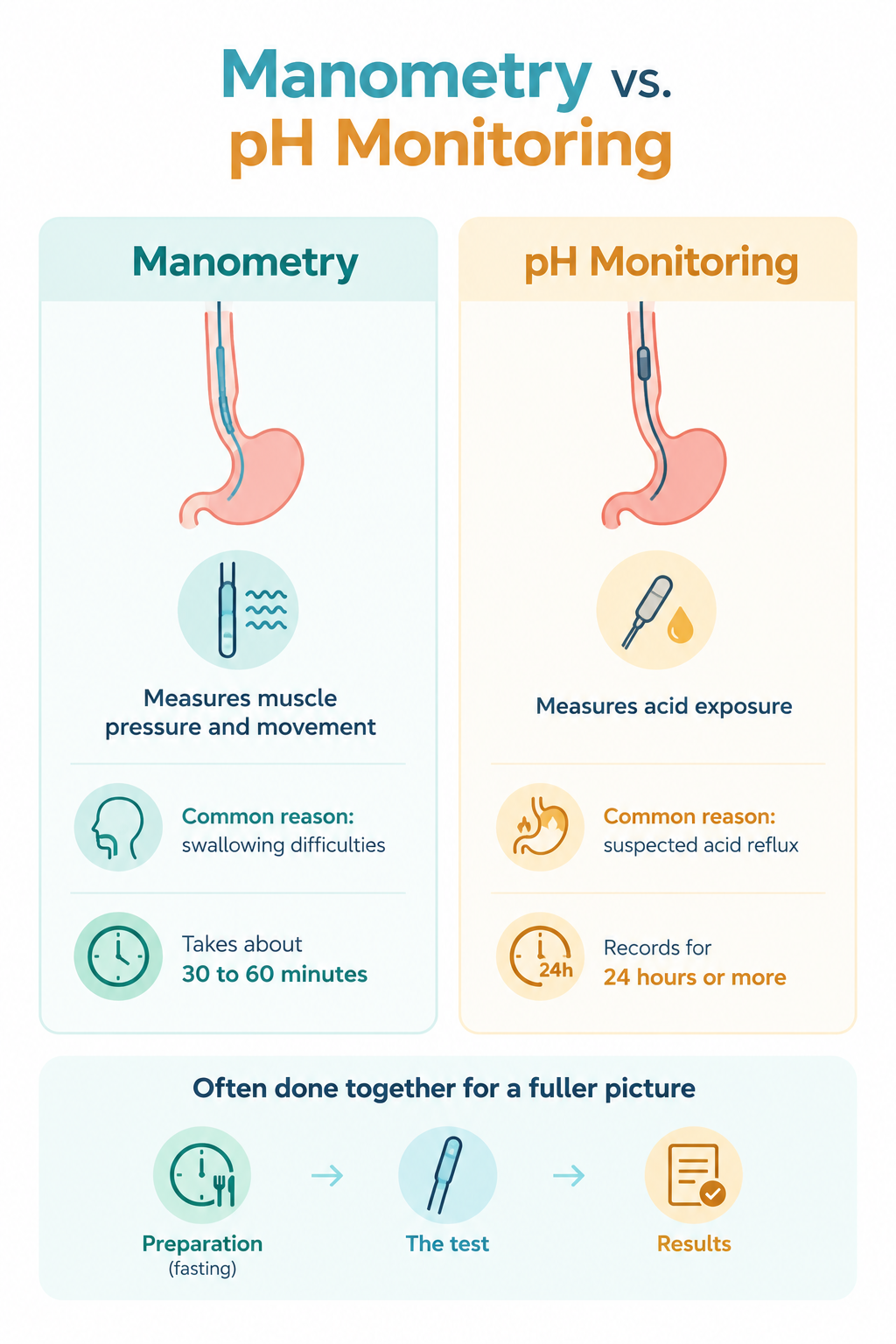
| Feature | Manometry | pH Monitoring |
| Main purpose | Measures oesophageal muscle pressure and movement | Measures acid exposure in the oesophagus |
| Common reason | Swallowing difficulties | Suspected acid reflux |
| What it evaluates | Muscle coordination and function | Frequency and duration of acid reflux |
Put simply, manometry asks whether the oesophagus is moving properly, and pH monitoring asks whether acid is getting where it shouldn’t. Neither replaces the other, which is why doctors often want both pieces of information.
What Happens After the Tests?
Once the tests are finished, you can usually go home and resume your normal routine. The tube is removed after manometry, and after a catheter pH study you’ll return to have it taken out. A wireless capsule simply passes on its own.
The recordings then need to be analysed. A specialist reviews the pressure patterns and the acid readings, matches them against your symptom diary, and puts together a report.
Your doctor will go through the results with you, and your rooms will tell you how long that takes.
It’s worth being clear on one thing. These tests are diagnostic. They don’t treat the underlying condition. What they do is guide treatment.
Depending on what’s found, your doctor might adjust your medication, recommend lifestyle changes or a reflux-friendly diet, suggest further tests such as a gastroscopy if one hasn’t been done, or discuss other options, including referral for a procedure if appropriate. The aim is an individual plan based on your results, rather than a general approach.
Frequently Asked Questions About Manometry and pH Studies
Are manometry and pH studies painful?
They’re not usually painful, but they can be uncomfortable. The gel or spray numbs your nose, and most people feel some gagging, watery eyes, or throat irritation while the tube is placed, which settles quickly. A sore throat or stuffy nose for a short time afterwards is common.
Do I need both tests?
Not always. Manometry is the main test for swallowing difficulties, and pH monitoring is the main test for confirming reflux. Many people need only one, but where symptoms overlap or the cause is unclear, your doctor may recommend both.
How should I prepare for the tests?
Follow the instructions you’re given. Typically, that means fasting for several hours and talking to your doctor about your medicines, some of which may need to be paused. Never stop a medicine without advice, and ask your doctor’s rooms if anything is unclear.
Can these tests confirm GERD?
pH monitoring is one of the best ways to confirm reflux disease, because it directly measures how much acid reaches the oesophagus and for how long. Together with your symptoms and endoscopy findings, it helps your doctor decide whether you have GERD or another condition.
How long does pH monitoring take?
It depends on the method. A catheter study usually records for about 24 hours, while a wireless capsule typically records for around two to four days. You’ll go about your normal day during the recording and keep a symptom diary.
When will I receive my results?
This varies, because the recordings must be analysed carefully before a report is made. Your doctor’s rooms will explain how long it takes and arrange a time to go over the results with you.
When to Consult a Gastroenterologist
You don’t need to wait until symptoms are severe. It’s sensible to seek assessment if you have heartburn that keeps coming back or doesn’t respond to treatment, food or liquid that sticks or comes back up, difficulty swallowing that is new or getting worse, chest discomfort that’s been checked and isn’t from the heart, or symptoms that simply aren’t improving. Warning signs such as unexplained weight loss, vomiting blood, black stools, or food that gets stuck and won’t pass need prompt medical attention.
A gastroenterologist can decide whether these tests are right for you, or whether another investigation should come first. If you’re looking for digestive care in Pretoria, our manometry and pH studies service is where these tests are carried out.
Book Your Consultation with Dr. Preetha Thomas
If persistent reflux, regurgitation, or swallowing difficulties are affecting your life, getting a clear answer is the first step toward the right treatment. Dr. Preetha Thomas, Gastroenterologist in Pretoria, can assess your symptoms, explain whether manometry and pH studies are appropriate, and guide you through what to expect. Book an appointment with Dr. Preetha Thomas today.
Conclusion: Understanding Your Digestive Health
Manometry and pH studies are two sides of the same investigation. One shows how well your oesophagus moves, and the other shows how much acid is reaching it. Together, they replace guesswork with measurement, which means treatment can be matched to what’s genuinely going on instead of what’s merely suspected.
If you’ve been living with symptoms that haven’t responded to treatment, it’s worth asking your doctor whether these tests could help. Understanding the cause is usually what turns ongoing frustration into a plan that works.
Disclaimer: This article is intended for general informational and educational purposes only. It does not constitute medical advice and should not be used to diagnose, treat, or manage any health condition. Preparation and procedures for manometry and pH studies vary, so always follow the instructions you are given, and never stop or change a medicine without medical advice. Difficulty swallowing with weight loss, vomiting blood, black stools, severe chest pain, or food that will not pass needs prompt medical attention. Please consult Dr. Preetha Thomas or another qualified healthcare professional regarding your specific symptoms and the tests appropriate for you.