
If you’ve been booked for a gastroscopy, it’s completely normal to wonder what you’ll feel afterwards. Will your throat hurt? Will you be bloated, groggy, or sick?
And how would you know if something wasn’t right? Knowing the gastroscopy procedure side effects in advance takes a lot of the worry out of the day.
The good news is that a gastroscopy is a very common and generally safe procedure. Most people feel a little sore, a little bloated, or a little sleepy afterwards, and then carry on with their lives. Serious complications are uncommon.
That said, there are warning signs that should never be ignored, and it helps to know the difference between what’s expected and what isn’t. This guide walks you through both, in plain language.
What Is a Gastroscopy and Why Is It Performed?
A gastroscopy is a procedure that lets a doctor look directly at the inside of your upper digestive tract.
A thin, flexible tube with a tiny camera and light on the end is passed through your mouth and gently guided down your throat, through the oesophagus (the food pipe), into the stomach, and on to the first part of the small intestine.
The camera sends live images to a screen, so the doctor can examine the lining in detail.
Gastroscopy is sometimes called an upper endoscopy or an OGD, and it’s one of the most useful tests in gastroenterology, because it shows things that scans and blood tests can’t.
Why a Gastroscopy May Be Recommended
A doctor may recommend a gastroscopy to find the cause of upper digestive symptoms that don’t settle or keep coming back. Common reasons include:
- Heartburn or indigestion that persists despite treatment, which may be linked to acid reflux that has progressed to GERD
- Difficulty or pain when swallowing
- Ongoing upper abdominal pain, nausea, or vomiting
- A persistent bitter taste in the mouth, which can sometimes point to a digestive cause
- Unexplained weight loss, anaemia, or signs of bleeding
- Checking for a hiatal hernia, ulcers, inflammation, or coeliac disease
- Looking for swollen veins (varices) in the oesophagus in people with advanced liver disease, including advanced fatty liver disease
If a doctor sees something unusual, small tissue samples (biopsies) can be taken during the same procedure, and some problems, such as bleeding or narrowing, can be treated at the same time.
How the Procedure Is Performed
You’ll be asked to fast for several hours beforehand, so your stomach is empty. According to the NHS, you’ll usually be offered a local anaesthetic throat spray, sedation, or both.
The spray numbs the back of your throat. Sedation, given through a small tube in your arm, helps you feel relaxed and sleepy.
You lie on your side, a small mouthguard protects your teeth, and the doctor passes the camera through your mouth. It doesn’t affect your breathing.
Air is gently introduced into the stomach so the lining can be seen clearly. The examination itself usually takes only about 5 to 15 minutes, though you’ll be at the unit longer to get ready and recover.
What Are the Common Side Effects of a Gastroscopy?
Most side effects are mild, short-lived, and a direct result of the way the procedure is done. They’re also the reason aftercare instructions exist. Here are the ones people mention most.
Sore Throat After Gastroscopy
A sore, scratchy, or slightly raw throat is the most common effect. It happens because the camera passes through the back of the throat, and the area can be irritated or mildly bruised. The numbing spray also leaves the throat feeling odd for a while, which can add to the sensation.
For most people, the soreness settles within a day. NHS hospital information leaflets commonly describe a sore throat lasting for the rest of the day or up to 24 hours, with a few quoting up to 48 hours. In the meantime, a few simple things can help:
- Wait until the numbness has worn off before eating or drinking, so you don’t choke or burn your mouth
- Sip cool or lukewarm drinks, and have soft foods at first
- Try warm (not hot) tea or a throat lozenge, once swallowing feels normal
- Rest your voice if it feels strained
Bloating and Trapped Wind
During the procedure, air is gently blown into your stomach to open it up and give the doctor a clear view. The doctor removes most of it before withdrawing the camera, but some usually remains. That leftover air is what causes the bloated, full feeling, along with burping and passing wind.
This is harmless and short-lived, and it’s actually a sign that things are settling. Walking gently around, rather than lying flat, helps the air move through. Warm drinks can also ease it. Fizzy drinks, on the other hand, add more gas, which is a good reason to skip them for the rest of the day.
Mild Stomach Pain or Abdominal Discomfort
Some people feel mild cramping, pressure, or a dull ache in the upper abdomen after the procedure. It usually feels like trapped wind, or like the discomfort you get after a heavy meal, and it eases as the air passes.
The NHS notes that some stomach and throat pain after a gastroscopy is normal and should pass in a few hours.
What matters is how it behaves. Mild, patchy discomfort that’s improving is expected. Pain that is severe, getting worse, spreading, or accompanied by a fever, a hard abdomen, or feeling very unwell is different, and needs prompt medical attention. Don’t wait it out.
Nausea After Gastroscopy
Some people feel queasy once the procedure is over. This can be caused by the sedation, by the air in the stomach, or by the camera stimulating the gag reflex. It’s usually mild and settles within a few hours.
Take things slowly. Start with small sips of water once you’re allowed, then move on to light food, and follow whatever your doctor or nurse has told you about eating and drinking. If nausea is severe, you’re vomiting repeatedly, or you can’t keep any fluids down, contact the clinic.
Drowsiness and Tiredness After Sedation
If you had sedation, expect to feel sleepy, a bit light-headed, and perhaps forgetful. This is the medicine doing its job, and it takes time to leave your system.
Many people don’t recall much of the procedure or the conversation afterwards, which is why it’s helpful to have someone with you when the doctor explains the results.
Although you may feel fairly alert after an hour or so, the effects of sedation can linger for up to 24 hours.
That’s why you can’t drive yourself home and should avoid driving, operating machinery, drinking alcohol, and signing important documents for the period your instructions specify. If you only had throat spray and no sedation, the restrictions are usually much lighter.
How Long Do Gastroscopy Side Effects Last?
Recovery is quick for most people, but it varies, and nobody can promise an exact timeline for every patient. As a general guide:
- Sore throat and mild irritation: usually improves within a few hours to a day, occasionally a little longer
- Bloating and trapped wind: typically eases within a few hours as the air passes
- Mild abdominal discomfort: usually settles within hours, and shouldn’t be getting worse
- Drowsiness after sedation: most of the grogginess clears within a few hours, but it’s wise to treat the whole day, and sometimes the next 24 hours, as a recovery period
Several things can affect how you feel. If biopsies were taken, you might notice a little more throat or stomach tenderness. If the doctor treated something during the procedure, such as stretching a narrowing, your recovery instructions may be more specific. Your age, general health, the type and amount of sedation, and how anxious you were beforehand can all play a part.
Are There Serious Complications After a Gastroscopy?
It’s worth being honest about this. Gastroscopy is generally a very safe procedure, and serious complications are uncommon. But they can happen, and knowing what they are helps you spot them early.
Bleeding After Gastroscopy
A small amount of bleeding can occur if biopsies were taken, or if a polyp was removed or another treatment was carried out. This is usually minor and settles by itself.
Significant bleeding is rare, but it needs urgent assessment. Signs include vomiting blood or something that looks like coffee grounds, and passing black, tarry stools.
Infection
Infection after gastroscopy is uncommon. If it happens, it usually shows up as a fever, worsening pain, or feeling progressively unwell in the hours or days afterwards. Anyone with these symptoms should be assessed promptly rather than assuming they’ll pass.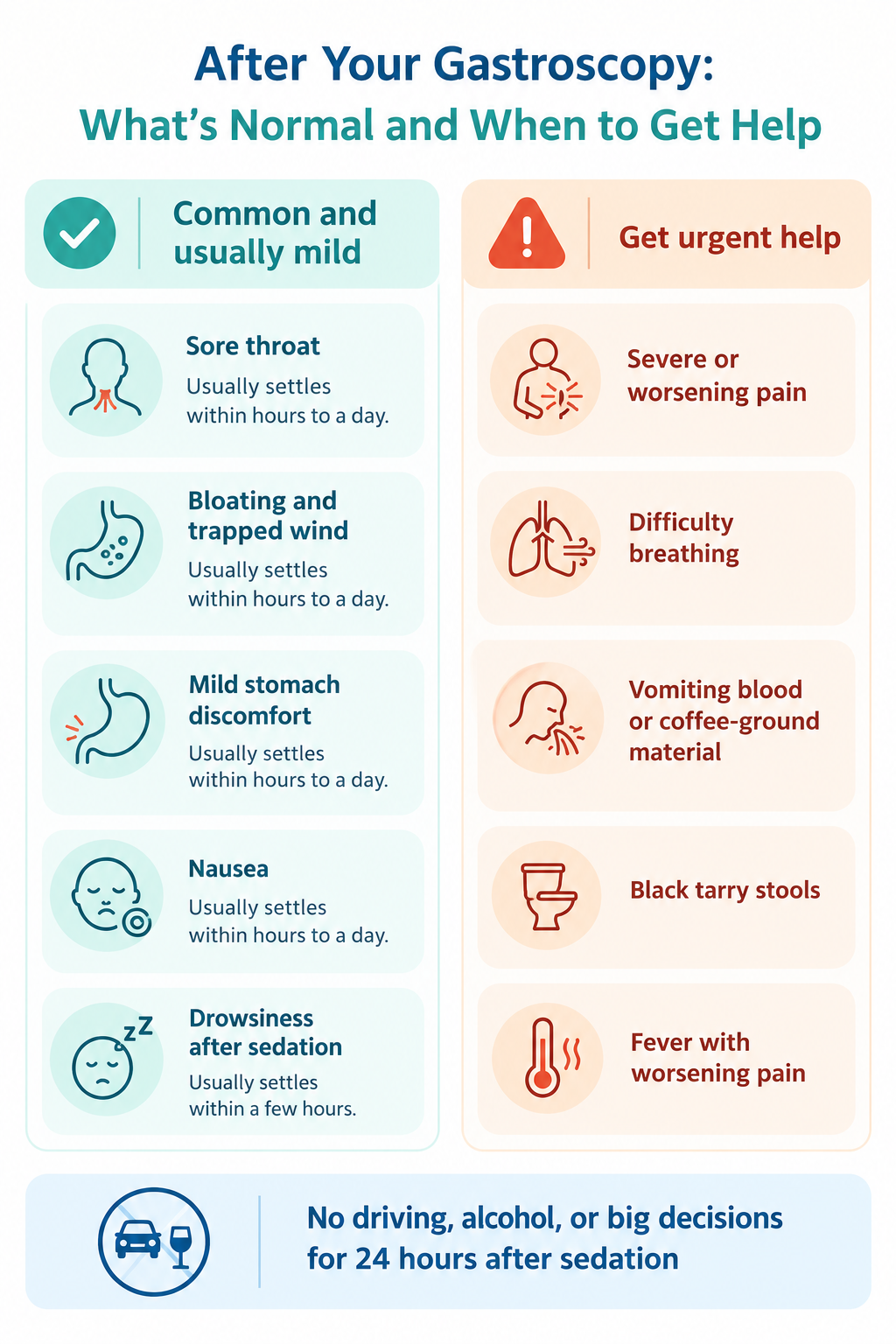
Perforation or Injury to the Digestive Tract
The most serious, though very rare, complication is a perforation, which is a small tear in the lining of the oesophagus, stomach, or duodenum. NHS hospital information puts the risk at roughly 1 in 1,000 for a diagnostic gastroscopy, as University Hospitals of Liverpool explains, and the risk is higher when a narrowing is being stretched or a treatment is performed.
If it happens, it needs admission to hospital and treatment. The warning signs are severe or worsening chest or abdominal pain, fever, and difficulty breathing, usually in the hours after the procedure.
Rarely, the camera can also damage loose teeth, crowns, or bridgework, which is why you’re asked to mention these beforehand.
Reactions to Sedation
Sedation can occasionally affect breathing, heart rate, or blood pressure, and some people react to the medicines or even to the throat spray. This is exactly why you’re monitored throughout.
Your oxygen levels, pulse, and blood pressure are watched closely, and oxygen is given if needed. Tell your doctor about any previous reactions to sedation or anaesthetic, and about heart or lung conditions, before the procedure.
Warning Signs to Watch for After a Gastroscopy
Most people never need this list, but it’s worth knowing. Seek urgent medical attention if you experience:
- Severe or worsening abdominal or chest pain
- Difficulty breathing, or difficulty swallowing that is new or getting worse
- Vomiting blood, or material that looks like coffee grounds
- Black, tarry stools, or significant bleeding
- Fever, especially with worsening pain or feeling very unwell
- Persistent vomiting that doesn’t settle
Follow your discharge instructions, and if you’re concerned about anything, contact your healthcare team. It’s always better to call and be reassured than to wait and worry.
How to Manage Common Side Effects After a Gastroscopy
A few sensible habits make recovery smoother. Remember that your own written instructions always take priority over general advice.
- Follow the instructions from the treating team, since they may differ depending on whether biopsies or treatment were done.
- Wait for the throat spray to wear off before you eat or drink. Your swallowing reflex needs to be back to normal, which can take up to an hour.
- Start with fluids and soft foods if your throat is sore, then return to your normal diet as comfort allows. Steer clear of very hot, spicy, or rough foods at first.
- Walk gently to help trapped wind move on.
- Rest after sedation, and have someone take you home and stay with you for the period advised.
- Avoid driving, alcohol, machinery, and big decisions for as long as your sedation instructions say.
- Take medication only as advised by your healthcare professional, and don’t restart or stop anything without checking.
One practical tip: once you’re eating normally again, choose gentle meals and go easy on the fizzy or very sugary drinks that day.
They can add gas and aggravate bloating. If you’re curious about the longer-term picture, our article on how sugar affects your digestive health explains why it’s worth watching.
What Should You Avoid After a Gastroscopy?
What you should avoid depends on whether you had sedation, biopsies, or treatment. In general:
- Driving after sedation. This is the most important rule. Sedation can slow your reactions long after you feel fine.
- Alcohol. It combines badly with the sedative still in your system, so avoid it until your instructions say it’s safe.
- Eating or drinking before the throat has recovered from the numbing spray. You could bite your tongue, burn your mouth, or choke without realising.
- Strenuous activity, if your doctor has advised against it, particularly after a treatment or procedure beyond a simple look.
- Ignoring new or worsening symptoms. Pain that’s getting worse, fever, or bleeding should never be put down to “just recovery.”
When Should You Contact Your Doctor After a Gastroscopy?
There are two levels of concern, and it helps to keep them separate.
Call your doctor or the clinic for advice if your sore throat is lasting longer than expected, you have ongoing discomfort that isn’t improving, nausea or vomiting that doesn’t settle, or symptoms that simply don’t improve the way you were told to expect. These aren’t emergencies, but they deserve a conversation.
Seek emergency care immediately if you have severe chest or abdominal pain, difficulty breathing, vomiting blood, black or bloody stools, or a fever with worsening pain. In that case, don’t wait for a callback. Go to your nearest emergency department and tell them you’ve recently had a gastroscopy.
Frequently Asked Questions About Gastroscopy Side Effects
Is it normal to have a sore throat after gastroscopy?
Yes. The camera passes through the back of your throat, which can leave it irritated. It usually improves within a day, and soft foods and cool drinks help in the meantime. If it’s severe, getting worse, or comes with difficulty swallowing or fever, contact your doctor.
Is stomach pain normal after a gastroscopy?
Mild discomfort or cramping from trapped air is common and usually eases within hours. Severe or worsening pain isn’t normal and shouldn’t be ignored, particularly if it comes with fever, vomiting, or feeling very unwell.
How long does it take to recover from a gastroscopy?
Many people feel back to normal within a few hours, and some return to usual activities the same day if they only had throat spray. If you had sedation, plan to rest for the rest of the day, and avoid driving and important decisions for 24 hours. Recovery can take a little longer if biopsies or treatment were performed.
Can you eat normally after a gastroscopy?
Usually yes, but not straight away. Wait until the numbing spray has worn off and you can swallow safely, then start with fluids and soft foods and move back to your normal diet as you feel comfortable. Follow the instructions you were given.
Can a gastroscopy cause serious complications?
Serious complications are uncommon, but they’re possible. They include significant bleeding, infection, a tear in the digestive tract, and reactions to sedation. Key warning signs are severe chest or abdominal pain, difficulty breathing, vomiting blood, black stools, and fever.
When should I seek medical help after a gastroscopy?
Seek urgent help for severe or worsening pain, difficulty breathing or swallowing, vomiting blood or coffee-ground material, black or bloody stools, or fever with worsening pain. For anything less urgent that’s worrying you, such as a lingering sore throat or ongoing nausea, call the clinic for advice.
Understanding Gastroscopy Side Effects
For most people, the side effects of a gastroscopy are mild and short-lived: a sore throat, a bit of bloating or trapped wind, some mild discomfort, and drowsiness if sedation was used. They settle quickly, and simple measures like gentle walking, soft foods, and rest usually help.
The important thing is knowing the difference between expected discomfort and warning signs. Severe or worsening pain, difficulty breathing, vomiting blood, black stools, or a fever are never normal, and they need prompt medical attention.
Follow your aftercare instructions closely, and if you’re unsure, ask. That’s what your healthcare team is there for.
Book Your Gastroscopy Consultation with Dr. Preetha Thomas
If you’ve been told you need a gastroscopy, or you’re living with heartburn, swallowing difficulty, or upper abdominal symptoms that haven’t been explained, you don’t have to work it out alone.
Dr. Preetha Thomas, Gastroenterologist in Pretoria, can assess your symptoms, explain exactly what to expect before and after the procedure, and answer your questions. Book a consultation with Dr. Preetha Thomas to take the next step with confidence.