

“Eat more fiber” has to be one of the most repeated pieces of health advice there is, and yet most people couldn’t tell you an actual number if you asked them. More than what?
More than yesterday? More than a bowl of bran flakes? The advice gets repeated so often that it’s somehow become both universal and vague at the same time.
Here’s the part that usually gets left out: there is an actual target, it varies by age and sex, and most people are eating roughly half of it.
This guide gives you the real numbers, explains why fiber matters so much for gut health specifically, and walks through how to get there without the bloating and discomfort that usually comes from doing it too fast.
What Fiber Actually Does for Your Gut
Fiber is the part of plant food your body can’t fully digest, and that’s exactly why it matters so much. Instead of being broken down and absorbed like other carbohydrates, fiber travels largely intact through your digestive system, and along the way it does two distinct jobs depending on the type.
Some fiber adds bulk and softness to stool, helping things move through the colon at a healthy pace, which is the basis of fiber’s well-known role in preventing constipation.
Other fiber becomes food for the trillions of bacteria living in your gut. Harvard Health explains that when fiber reaches your gut, enzymes from your gut bacteria break it down into short-chain fatty acids, compounds that are thought to lower the pH inside the colon and make it a less hospitable environment for harmful microorganisms.
In other words, fiber isn’t just moving things along, it’s actively shaping which bacteria thrive in your gut and how well your gut barrier functions.
This matters well beyond simple regularity. Short-chain fatty acids serve as a direct energy source for the cells lining your colon, help maintain the integrity of your gut barrier, and play a role in regulating inflammation throughout the body, not just locally in the gut.
A gut that’s regularly fed a good supply of fiber tends to host a more diverse, resilient population of these fermenting bacteria, and diversity in the gut microbiome has been linked to better outcomes across a surprisingly wide range of health markers, from blood sugar control to immune function.
How Much Fiber Do You Need? Daily Fiber Requirements by Age and Sex
This is the number most people actually want, so here it is directly. According to Mayo Clinic, the recommended daily fiber intake is as follows:
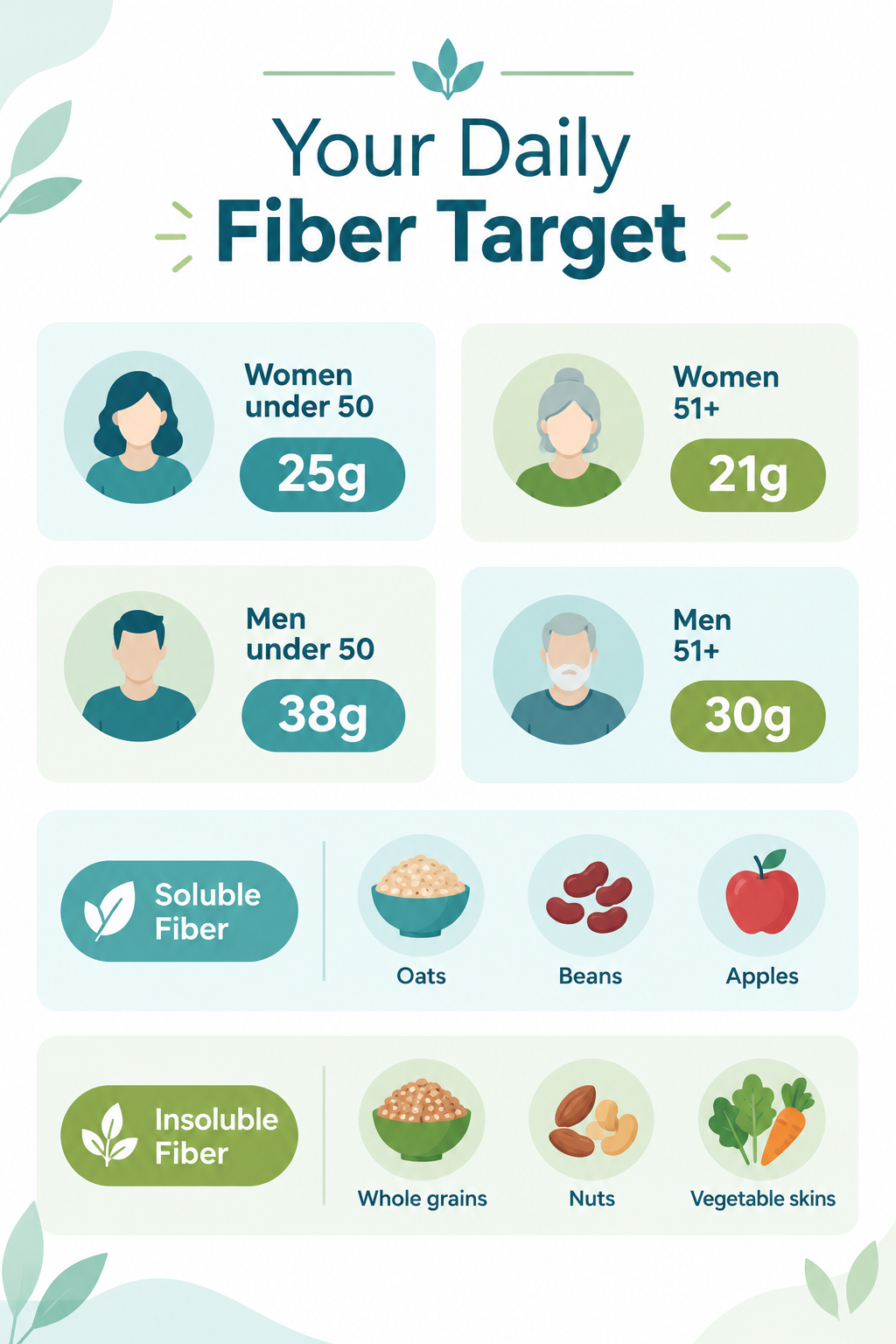
- Women aged 50 and younger: 25 grams per day
- Women aged 51 and older: 21 grams per day
- Men aged 50 and younger: 38 grams per day
- Men aged 51 and older: 30 grams per day
The drop after 50 reflects lower overall calorie needs as metabolism slows with age, not a reduced need for fiber’s other benefits. If anything, fiber becomes more important later in life, since digestion naturally slows and constipation becomes more common.
Here’s the uncomfortable statistic worth knowing: the average adult eats only around 15 grams of fiber a day, roughly half the recommended amount, and fewer than one in ten people actually meet their target. If that sounds like you, you’re in the overwhelming majority, not an outlier.
Are You Getting Enough? Signs of Fiber Deficiency
Because most people are already below target, it’s worth checking whether some of your ongoing digestive complaints trace back to this rather than something more complicated. Common signs that fiber intake may be too low include:
- Frequent constipation or infrequent bowel movements
- Stools that are hard, dry, or difficult to pass
- Feeling hungry again soon after meals
- Blood sugar that spikes and crashes noticeably after eating
- Elevated cholesterol on recent blood work
- A diet that’s heavy in refined grains, meat, and processed snacks, with few vegetables, fruits, or whole grains
None of these symptoms confirm fiber is the sole cause, but if several apply and your diet genuinely is low in plant foods, increasing fiber intake is a reasonable, low-risk first step before assuming something more serious is going on.
A simple way to get a rough sense of where you stand is to track your intake for a few typical days, most nutrition apps will total it up automatically, and compare that figure honestly against the targets above rather than assuming your usual habits are already covering it.
Soluble vs. Insoluble Fiber: Why the Type Matters
“How much fiber” is only half the picture. Which kind matters just as much, because soluble and insoluble fiber do genuinely different jobs.
Soluble fiber dissolves in water and forms a gel-like substance in the gut. It’s particularly good at lowering LDL cholesterol, helping regulate blood sugar, and feeding beneficial gut bacteria. You’ll find it in oats, beans, lentils, apples, and citrus fruits.
Insoluble fiber doesn’t dissolve and instead adds bulk to stool, helping it move through the intestines more efficiently. This is the fiber most directly responsible for preventing constipation and keeping bowel movements regular. It’s found in whole grains, wheat bran, nuts, and the skins of many vegetables and fruits.
Most whole plant foods contain a mix of both, which is part of why eating a genuine variety of plant foods tends to work better than fixating on a single “high fiber” food or supplement.
Best High-Fiber Foods for Gut Health
Whole foods are the preferred source of fiber, partly because they deliver fiber alongside a whole range of other nutrients a supplement can’t replicate.
Strong everyday sources include legumes such as lentils, chickpeas, and black beans, which are among the most concentrated fiber sources available, along with whole grains like oats, brown rice, and whole wheat bread.
Fruits such as raspberries, pears, and apples (with the skin on) and vegetables like broccoli, carrots, and leafy greens all contribute meaningfully too, as do nuts and seeds such as chia, flaxseed, and almonds.
A genuinely high-fiber breakfast is one of the easiest wins available, since it can cover a significant chunk of your daily target before lunch.
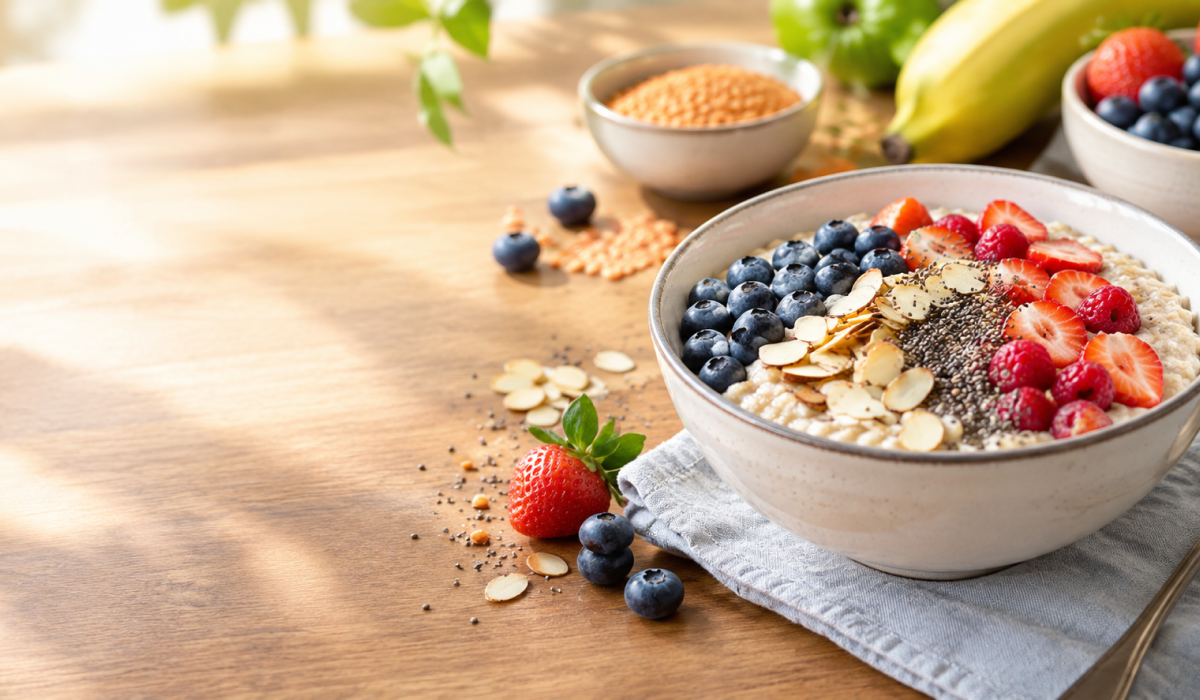
A bowl of oats or a high-fiber cereal, topped with berries and a spoon of chia or flax seeds, can deliver well over a quarter of your daily goal in a single meal.
It helps to think in terms of swaps rather than entirely new habits. Choosing a wholegrain bread or wrap instead of a white one, adding a handful of lentils or beans to a soup or salad you’d already be making, or snacking on fruit and a small handful of nuts instead of a packaged snack bar all add up meaningfully over a week without requiring a complete overhaul of how you eat.
None of these changes need to feel extreme to move the needle, consistency across ordinary meals tends to outperform the occasional elaborate “healthy” dish.
It’s also worth pairing fiber-rich meals with fermented foods, since fiber feeds the beneficial bacteria that fermented foods help introduce in the first place. The two work well together rather than as separate, unrelated strategies.
Fiber Supplements vs. Whole Foods
Supplements such as psyllium husk, methylcellulose, or inulin can genuinely help close the gap when diet alone isn’t getting you there, and psyllium in particular has solid evidence for improving stool regularity.
That said, supplements typically provide only one type of fiber, rather than the full mix of soluble, insoluble, vitamins, and minerals that whole foods provide, and they don’t deliver the same broad benefit to gut bacteria diversity that a varied plant-based diet does.
The sensible approach is to prioritise food first, and use a supplement to fill genuine gaps rather than as a substitute for eating more plants. If you do use one, start at a low dose and increase gradually, the same caution that applies to dietary fiber applies here too.
It’s also worth checking the label on any supplement you consider, since products vary considerably in fibre type, dose per serving, and added sugars or sweeteners, and not every “fibre” product on a pharmacy shelf is formulated the same way.
How to Increase Fiber Intake Safely
This is where a lot of people go wrong, and it’s also why some people conclude “fiber doesn’t agree with me” after one bad experience.
Jumping from 15 grams a day to 35 grams overnight is a near-guaranteed way to end up gassy, bloated, and uncomfortable, not because fiber is the wrong choice, but because your gut bacteria need time to adjust to fermenting a larger volume of fibre.
A better approach is to add fiber gradually, aiming to increase by around five grams every few days rather than doubling your intake overnight. Increase your water intake at the same time, since fiber needs adequate fluid to do its job properly, and without it, a higher fiber intake can actually worsen constipation rather than relieve it.
Spread fiber across meals throughout the day instead of loading it all into one, and introduce new fiber sources one at a time so you can identify anything that genuinely doesn’t agree with you, rather than blaming fiber in general.
If you’re also dealing with reflux symptoms while increasing fiber intake, our GERD diet plan can help you choose fiber sources that won’t aggravate heartburn at the same time.
It’s also worth giving any single change a genuine trial period before judging it. A week or two of mild adjustment while your gut bacteria recalibrate to a higher fibre load is normal and expected, not a sign that something is wrong.
Most people find that the initial bloating or gas that comes with a fibre increase settles meaningfully within two to three weeks, provided the increase has been gradual rather than abrupt.
Can You Eat Too Much Fiber? How Much Fiber Is Too Much
Yes, it’s possible, though it’s considerably less common than falling short. Consuming an unusually high amount, particularly from supplements rather than food, can cause bloating, cramping, gas, and in some cases interfere with how well your body absorbs certain minerals such as iron, zinc, and calcium.
As a general guide, going much beyond 50 to 70 grams a day, especially from concentrated supplement sources rather than a varied diet, isn’t necessary and can start working against you rather than for you. For most people eating a genuinely varied, whole-food diet, reaching an excessive level through food alone is unlikely, since whole foods are naturally self-limiting in a way concentrated supplements aren’t.
The much more common problem remains the opposite one, simply not eating enough, and most people would need to make a deliberate, concerted effort to overshoot their target through diet alone.
Fiber and IBS: Why More Isn’t Always Simple
Fiber and IBS have a more complicated relationship than “eat more fiber, feel better,” and it’s worth being upfront about that rather than giving blanket advice that doesn’t hold up for everyone. Soluble fiber tends to be well tolerated and even helpful for IBS, particularly for constipation-predominant symptoms, while insoluble fiber, especially wheat bran, can worsen bloating and discomfort for some people with IBS rather than improving it.
If you’re managing IBS, the right fiber amount and type is genuinely individual, and it often needs to be figured out alongside broader dietary strategies such as a low FODMAP approach rather than treated as a standalone fix. Our detailed guide on IBS treatment options covers how fiber fits into a wider, more tailored management plan.
It’s also worth knowing that certain high-fiber foods, onions and garlic among them, show up on lists of foods that commonly aggravate sensitive digestion, which is a useful cross-check if you’re increasing fiber and noticing new symptoms rather than improvement.
One more practical note: if a stomach bug or bout of food poisoning has recently disrupted your gut, it’s worth easing back into higher fiber intake gradually rather than all at once. Our guide on managing food poisoning symptoms covers how to reintroduce normal eating safely once the acute illness has passed.
When to See a Gastroenterologist About Your Digestion
For most people, increasing fiber gradually and staying well hydrated resolves mild, diet-related constipation or irregularity within a few weeks.
It’s worth seeing a gastroenterologist if increasing fiber hasn’t improved your symptoms after a genuine, consistent trial, if you’re experiencing significant bloating, pain, or a noticeable change in bowel habits that doesn’t settle, or if you notice blood in your stool, unexplained weight loss, or symptoms that are worsening rather than improving.
These aren’t things to keep adjusting your diet around indefinitely, they’re signals that a proper evaluation is the next step.
Still Dealing with Digestive Discomfort? Talk to Dr. Preetha Thomas.
If you’ve increased your fiber, cleaned up your diet, and you’re still dealing with bloating, irregular bowel habits, or ongoing discomfort, diet alone may not be the full answer. Dr. Preetha Thomas, gastroenterologist in Pretoria, can properly evaluate what’s actually going on and build a plan around your specific gut. Book a consultation to get a clear answer instead of continuing to guess.
Frequently Asked Questions
How much fiber should I eat per day?
Most adult women should aim for 25 grams a day under age 50, dropping slightly to 21 grams after 50. Most adult men should aim for 38 grams under 50, dropping to 30 grams after 50.
Can too much fiber cause bloating?
Yes, particularly when intake is increased too quickly. Gradual increases paired with adequate water intake generally prevent this, and bloating from fiber is usually temporary as your gut bacteria adjust.
What’s the fastest way to increase fiber without discomfort?
There isn’t really a fast way that avoids discomfort entirely. Increasing by around five grams every few days, spreading intake across meals, and drinking enough water is the most reliable way to get there comfortably.
Is fiber good for IBS or can it make it worse?
Both, depending on the type and the person. Soluble fiber is generally well tolerated and often helpful, particularly for constipation-predominant IBS, while insoluble fiber can worsen symptoms for some people. It’s worth figuring out your individual tolerance rather than assuming more fiber is automatically better.
Do fiber supplements work as well as food?
Supplements can help close a genuine gap and have real evidence behind them, particularly psyllium, but they typically provide only one type of fiber and lack the broader nutritional benefits of whole foods. Food should generally be the first approach, with supplements used to fill remaining gaps.
Disclaimer: This article is intended for general informational and educational purposes only. It does not constitute medical advice and should not be used to diagnose, treat, or manage any health condition. Please consult Dr. Preetha Thomas or another qualified gastroenterologist regarding your specific symptoms and dietary needs.