


If you’ve been dealing with IBS for a while, you’ve probably already tried something. Maybe you cut out dairy, bought a probiotic that promised to fix everything, or started avoiding certain foods based on a tip from a friend or a forum.
Some of it may have helped a little. Most people find that trial and error on their own only gets them so far.
That’s not a failure on your part. IBS treatment genuinely isn’t one-size-fits-all, and getting real, lasting relief usually means combining the right approaches in the right order, matched to your specific pattern of symptoms.
This guide walks through what actually works, what the evidence says, and what a gastroenterologist adds that self-directed management can’t.
What Is IBS, Briefly
Irritable bowel syndrome is a long-term condition affecting how the large intestine works, causing recurring abdominal pain along with changes in bowel habits.
It’s extremely common, affecting roughly one in ten adults, and it doesn’t damage the digestive tract the way inflammatory conditions do.
If you’d like the fuller picture, including causes and symptoms, our guide on what IBS is and what causes it covers that in depth. This article focuses specifically on treatment.
Why IBS Treatment Isn’t One-Size-Fits-All
The first thing worth understanding is that IBS isn’t a single condition with a single fix. Someone with constipation-predominant IBS (IBS-C) needs a very different approach from someone with diarrhoea-predominant IBS (IBS-D), and someone with mild, occasional symptoms needs a lighter touch than someone whose symptoms are severe and disrupting daily life.
Mayo Clinic notes that treatment typically starts with the basics, dietary changes, fibre, and stress reduction, before moving on to medication aimed at your specific symptoms.
This stepped approach matters because jumping straight to medication without addressing diet, or trying every diet without ever considering medication, both tend to leave people stuck.
A proper plan builds in layers, and which layers you need depends on your subtype and how severe things are.
IBS Diet Treatment: Where Most People Start
Diet is usually the first and most logical place to start, partly because food is something you can act on immediately, and partly because it genuinely works for a lot of people.
General first steps include reducing high-fat and fried foods, which can trigger painful contractions, cutting back on carbonated drinks and alcohol if bloating is a problem, and eating regular, smaller meals rather than large ones.
Some people with diarrhoea-predominant symptoms also find relief by reducing gluten, even without coeliac disease, though the evidence here is mixed and it’s not a universal recommendation.
Low FODMAP Diet for IBS Treatment
The low FODMAP diet is the most evidence-backed dietary approach for IBS. FODMAPs are a group of fermentable carbohydrates, found in foods like onions, garlic, wheat, certain fruits, and dairy, that draw water into the bowel and ferment in the gut, producing gas, bloating, and altered bowel habits in sensitive people.
Mayo Clinic explains that the diet helps roughly half of people with IBS, with particular benefit for those with diarrhoea-predominant symptoms, though it doesn’t work the same way for everyone.
The diet works in stages: a strict elimination period, followed by a structured reintroduction of each FODMAP group to identify your specific triggers. It’s not meant to be a permanent restriction.
Our full guide on how to follow a low FODMAP diet for IBS relief walks through each stage, and doing it with a dietitian or doctor’s guidance generally gets better results than attempting it alone.
Fibre Supplements for IBS
Fibre is often used as a first-line therapy, particularly for constipation-predominant IBS, with a gradual increase towards 20 to 30 grams a day recommended.
The type matters. Soluble fibre, found in oats, psyllium, and some fruits, tends to be better tolerated than insoluble fibre like wheat bran, which can worsen bloating in some people. Increasing fibre too quickly is a common mistake, slow, gradual increases give your gut time to adjust.
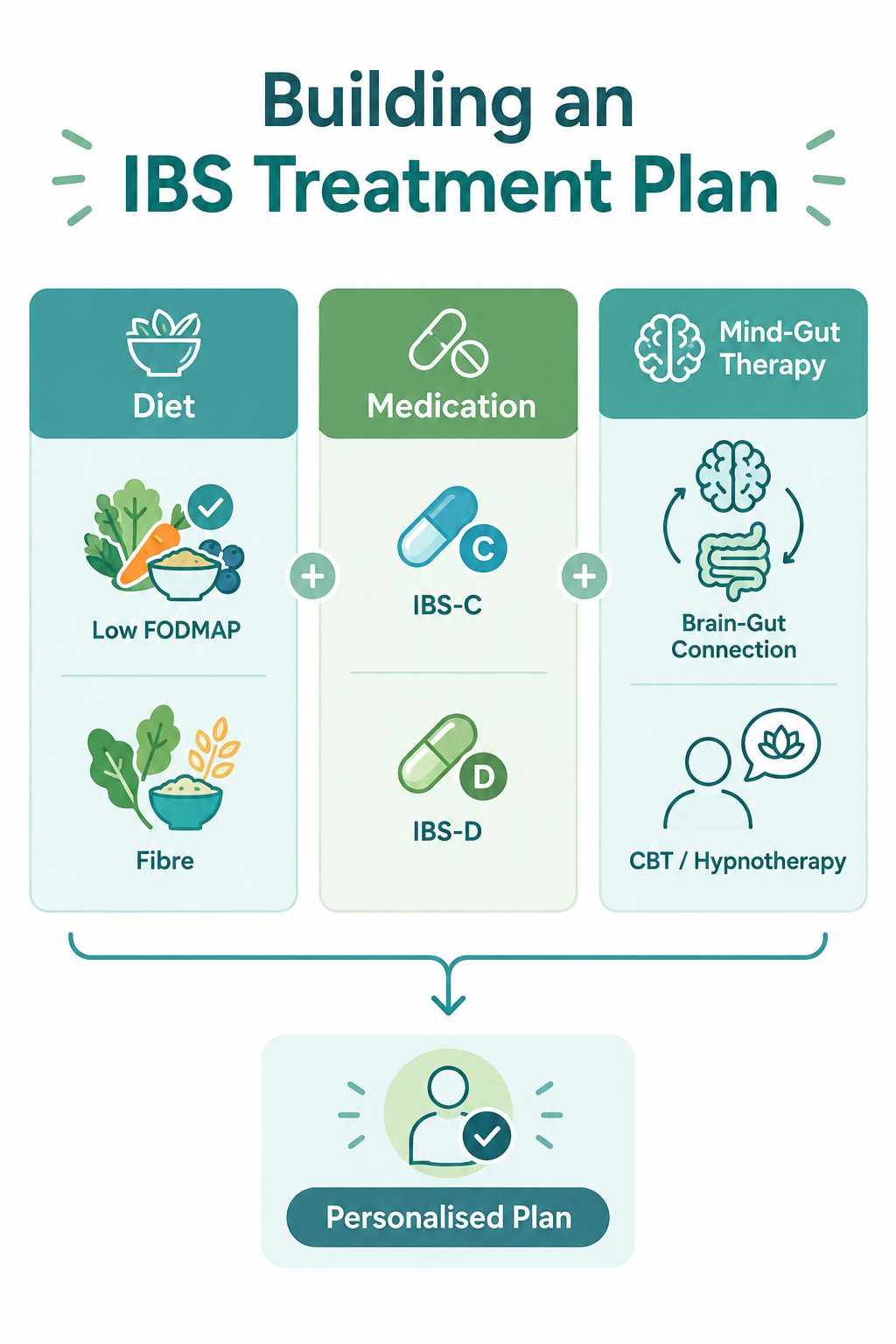 Infographic Alt Text:“Infographic showing three layers of IBS treatment, diet, medication, and mind-gut therapy, combining into a personalised treatment plan”
IBS Medication: What a Doctor Can Prescribe
When diet alone isn’t enough, medication becomes the next layer, and this is where having a doctor involved makes a real difference, since the right medication depends heavily on your dominant symptom.
Laxatives for IBS-C
For constipation-predominant IBS, osmotic laxatives can help soften stool and ease the frequency problem once fibre alone isn’t cutting it. Prescription options exist too for more persistent constipation that hasn’t responded to simpler measures.
Antidiarrhoeals for IBS-D
For diarrhoea-predominant IBS, medications that slow gut transit can reduce urgency and frequency. These are generally used as needed rather than continuously, and a doctor can help you figure out the right pattern of use rather than relying on them daily without a plan.
Antispasmodics for IBS Pain and Bloating
Antispasmodic medications work by relaxing the muscles of the gut wall, which can ease cramping, pain, and the sense of bloating that comes with it. These are often used around mealtimes or when symptoms are triggered by specific situations, rather than as a constant daily medication.
Antidepressants for IBS Pain
This one surprises people, and it’s worth explaining clearly so it doesn’t sound like your pain is being dismissed as psychological. Certain antidepressants, used at low doses, act on the nerve signalling between the gut and brain, which is central to how IBS pain works.
They’re prescribed here for their effect on gut nerve sensitivity, not because IBS is “in your head.” This is a legitimate, well-established treatment for persistent IBS pain that hasn’t responded to other measures.
New IBS Medications
Several newer prescription medications have been developed specifically for IBS-C and IBS-D in recent years, targeting gut motility and sensation more precisely than older options. These tend to be considered when first-line treatments haven’t given adequate relief, and a gastroenterologist is best placed to know which, if any, fits your situation.
Natural Remedies for IBS: What Actually Has Evidence
A lot of products marketed as “natural IBS remedies” don’t have strong evidence behind them, and it’s worth being honest about that rather than recommending everything on a supplement shelf. Two specific things genuinely do have real evidence.
Peppermint oil, specifically an enteric-coated form that releases in the small intestine rather than the stomach, has been shown in studies to ease bloating, urgency, and abdominal pain, particularly for diarrhoea-predominant symptoms. It’s one of the few “natural” options with genuinely solid research behind it.
Probiotics have shown promise for symptoms like bloating, pain, and altered bowel habits in some studies, though results vary by strain and individual. Not every probiotic product has been tested specifically for IBS, so it’s worth being selective rather than assuming any probiotic will help. Our guide to probiotics, prebiotics, and gut health explains how to choose more carefully.
Beyond these two, be cautious of remedies promising a complete cure. IBS is managed, not cured, by any single product, and claims suggesting otherwise are usually overstated.
Mind-Gut Treatment: CBT, Hypnotherapy, and Stress Management
Because IBS is now understood as a disorder of gut-brain interaction, treatments that work directly on that communication pathway aren’t an alternative add-on. They’re a legitimate, evidence-based part of treatment, and for some people they’re the piece that finally moves the needle after diet and medication alone haven’t been enough.
Cognitive behavioural therapy adapted specifically for IBS helps patients change how they respond to and manage symptoms, and it has shown real, lasting benefit in research.
Gut-directed hypnotherapy, which sounds unconventional but has solid clinical support, works similarly, specifically targeting the gut-brain pathway rather than being a general relaxation technique.
Stress management more broadly, including regular exercise, good sleep, and simple relaxation practices, supports all of this. Our article on how stress affects your digestion explains the mechanism behind why this matters so much for IBS specifically.
These approaches are particularly worth considering if psychological factors are clearly part of your pattern, or if medication and diet changes haven’t given you the relief you’re after.
How Long Does IBS Treatment Take to Work?
This varies by approach, and it’s worth setting realistic expectations rather than expecting instant results. Dietary changes, particularly the low FODMAP diet, often show initial improvement within two to six weeks, though full reintroduction and personalisation takes longer.
Fibre adjustments typically take several weeks of gradual increase before symptoms improve.
Medications aimed at specific symptoms, like antispasmodics or antidiarrhoeals, often work within days for that particular symptom, while medications targeting gut-brain pain signalling usually take several weeks to show their full effect.
CBT and hypnotherapy are typically delivered over a course of weeks to months, with benefits that tend to be more durable once achieved.
The honest answer is that IBS treatment is rarely instant, and most people see gradual improvement over weeks to months rather than a single turning point. That’s exactly why having a proper plan, rather than switching strategies every few days out of frustration, tends to produce better results.
Is There an IBS Treatment That Actually Works?
There’s no single universal answer that works the same way for everyone, and that’s the honest truth rather than a disappointing one.
What the evidence consistently shows is that a combination approach, tailored to your subtype and severity, works far better than any single intervention used alone.
Diet alone helps some people considerably and barely touches symptoms for others. Medication alone can manage specific symptoms but doesn’t address underlying gut-brain sensitivity. Mind-gut therapies work well for some and aren’t necessary for others.
The “treatment that actually works” isn’t a specific product or diet. It’s the right combination, built around your actual pattern of symptoms, and adjusted over time as you learn what helps and what doesn’t.
How a Gastroenterologist Builds Your IBS Treatment Plan
This is where professional input changes the picture. A gastroenterologist starts by properly confirming the diagnosis, which includes ruling out conditions that can mimic IBS, such as coeliac disease or inflammatory bowel disease, so you’re not treating the wrong thing.
From there, identifying your specific subtype and the symptoms that bother you most shapes which treatments are worth trying first, rather than working through options randomly.
A specialist can also combine approaches in a way that’s hard to coordinate alone, pairing dietary guidance with the right medication, and knowing when mind-gut therapies are likely to add real value versus when they’re unlikely to be the missing piece.
And because IBS tends to shift over time, a proper treatment relationship means your plan gets adjusted as your pattern changes, rather than staying static while your symptoms evolve around it.
When to See a Doctor for IBS Treatment
It’s worth seeing a gastroenterologist if self-directed changes, diet adjustments, over-the-counter products, basic lifestyle changes, haven’t meaningfully improved your symptoms after a reasonable trial.
It’s also worth seeing one if you’ve never had a proper diagnosis and have simply been assuming it’s IBS, if your symptoms are significantly affecting your daily life, or if you’re unsure which treatments are actually appropriate for your specific pattern rather than guessing from general advice.
Ready to Build an IBS Treatment Plan That Actually Works?
Guessing your way through diets, supplements, and medications is exhausting, and it rarely gets you as far as a properly built plan does. Dr. Preetha Thomas, gastroenterologist in Pretoria, can confirm your diagnosis, identify your IBS subtype, and put together a treatment plan that actually matches your symptoms. Book a consultation to stop guessing and start getting real relief.
Frequently Asked Questions
Can IBS be cured or only managed?
There’s currently no cure for IBS. It’s a long-term condition that’s managed through diet, medication, and mind-gut approaches, with the goal of reducing symptoms and flare-ups rather than eliminating the condition entirely.
What is the first-line treatment for IBS?
Most treatment plans start with dietary changes and lifestyle adjustments, sometimes alongside fibre, before moving on to targeted medication or mind-gut therapies if symptoms persist.
Do I need medication for IBS, or can diet alone work?
For some people, diet alone, particularly the low FODMAP diet, provides substantial relief. For others, medication or mind-gut therapies are needed alongside dietary changes. It depends on your individual symptoms and how you respond to initial changes.
Is peppermint oil safe for IBS?
Enteric-coated peppermint oil has reasonable evidence for easing IBS symptoms and is generally considered safe for most people, though it’s worth checking with your doctor, particularly if you have reflux, since peppermint can worsen heartburn in some people.
How do I know which IBS treatment is right for me?
This depends on your specific subtype, your dominant symptoms, and how severe your IBS is. A proper evaluation with a gastroenterologist is the most reliable way to figure out which combination of treatments is likely to help you specifically, rather than guessing from general advice.
Disclaimer: This article is intended for general informational and educational purposes only. It does not constitute medical advice and should not be used to diagnose, treat, or manage any health condition. Please consult Dr. Preetha Thomas or another qualified gastroenterologist regarding your specific symptoms and treatment options.