

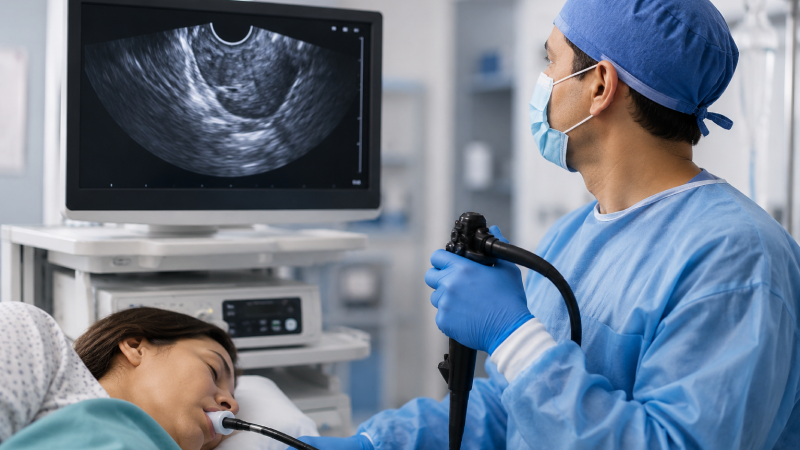
If your doctor has just mentioned the words “endoscopic ultrasound” and moved on to scheduling before you could ask a single question, you’re not alone. Most patients hear about EUS for the first time the day it’s ordered, and the name alone doesn’t explain much. It sounds like two separate tests bolted together, and in a way, it is.
Here’s what actually happens, step by step, from the moment you’re booked to the moment you’re home again.
What Is an Endoscopic Ultrasound?
An endoscopic ultrasound, usually shortened to EUS, combines two tools your gastroenterologist already uses separately: an endoscope and an ultrasound probe. As Cleveland Clinic explains, the endoscope is a thin, flexible tube with a light and a tiny camera on the end. The ultrasound probe, mounted right at the tip of that same tube, sends out sound waves to build a picture of what’s just beneath the surface, not only what the camera can see.
That distinction matters. A standard endoscopy or colonoscopy shows the doctor the lining of your digestive tract, the surface layer. A regular ultrasound, the kind done on your belly with a probe pressed against the skin, has to send sound waves through skin, fat, and muscle before it even reaches the organ in question, which limits how sharp the image can be.
EUS skips both limitations. Because the ultrasound probe travels inside your body on the endoscope, it ends up sitting right next to the organ being examined, sometimes only a few millimetres away. According to the American Society for Gastrointestinal Endoscopy’s patient resource, that proximity is what lets a gastroenterologist see fine detail in the pancreas, the walls of the stomach or oesophagus, nearby lymph nodes, and other structures that are otherwise hard to image clearly.
Why Would You Need One?
EUS isn’t usually a first step. Most patients are referred for it after something else, a symptom, a blood test, or an earlier scan, raised a question that needs a closer look. Common reasons include:
- Unexplained abdominal or chest pain
- A mass or abnormality spotted on a CT or MRI, particularly near the pancreas
- Unexplained weight loss
- Evaluating the depth or spread of a tumour already found in the digestive tract
- Assessing bile duct or pancreatic duct problems
- Investigating swallowing difficulties or suspected Barrett’s oesophagus, often linked to chronic acid reflux
If your doctor has ordered an EUS, it’s typically because they need a level of detail that a CT scan or standard endoscopy alone can’t provide.
How to Prepare for an Endoscopic Ultrasound
Preparation is fairly similar to what you’d do before a standard endoscopy, though your doctor’s office will give you exact instructions for your specific case.
Fasting.
You’ll usually need to stop eating and drinking for at least six to eight hours before the procedure, often from midnight the night before. An empty stomach means a clearer view and a safer procedure under sedation.
Medications.
If you’re on blood thinners, mention this well before your appointment date. Your doctor may ask you to pause certain medications temporarily, though this decision depends entirely on your individual health history, so don’t stop anything without being told to.
Arranging a ride.
Because sedation is involved, you won’t be allowed to drive yourself home. Plan for someone to collect you, or arrange transport in advance.
Lower EUS prep.
If the exam is looking at the rectal area rather than the upper digestive tract, a bowel prep similar to a colonoscopy prep may be required.
What Happens During the Procedure, Step by Step
Sedation and Getting Started
Once you’re checked in, a nurse will place an IV line and administer sedation. Most patients are given a light to moderate sedative that leaves them drowsy and comfortable rather than fully unconscious, though the exact approach depends on your case and your doctor’s judgment. You won’t feel the procedure itself, and most patients remember very little of it afterward.
How the Scope Is Guided In
For an upper EUS, the endoscope is guided gently through your mouth, down the oesophagus, and into the stomach and the first part of the small intestine. For a lower EUS, it’s guided through the rectum instead. Either way, the scope itself is thin and flexible, and sedation means you shouldn’t feel discomfort as it moves through.
What the Doctor Is Looking At
As the scope travels, your gastroenterologist watches two images at once: the standard camera view of the tissue surface, and the ultrasound image of what lies beneath it. This is where EUS earns its reputation for precision. Structures like the pancreas, bile ducts, and lymph nodes sit just outside the digestive tract wall, and from this close range, even small abnormalities tend to show up clearly.
If a Biopsy Is Needed (Fine Needle Aspiration)
If something worth sampling turns up, your doctor can take a tissue or fluid sample right then, using a thin needle passed through the scope and guided precisely by the ultrasound image. This is called fine needle aspiration, and it means a separate biopsy procedure usually isn’t necessary. The sample is sent to a lab for analysis afterward.
The entire procedure, biopsy included, typically takes between twenty minutes and an hour, depending on what’s being examined and whether tissue sampling is needed.
Is an Endoscopic Ultrasound Painful?
No, and this is usually the question patients care about most. Because you’re sedated throughout, you shouldn’t feel pain during the procedure itself. Some people experience mild throat soreness afterward if the upper route was used, similar to how your throat might feel after a cold, and this typically settles within a day. A little bloating or gas discomfort is also common in the hours afterward, especially if air was used to help the doctor see clearly, and it resolves on its own.
How Long Does It Take?
Most EUS procedures take twenty to sixty minutes from start to finish. Add on time for check-in, sedation, and recovery, and you should expect to be at the facility for two to three hours in total, even though the procedure itself is relatively brief.
Recovery and Getting Your Results
You’ll be moved to a recovery area until the sedative wears off, usually thirty minutes to an hour. Because you won’t be fully alert right away, someone else needs to drive you home, and it’s best to avoid important decisions, work, or operating machinery for the rest of that day.
Your doctor will typically go over the initial findings with you before you leave, or shortly after. If a biopsy was taken, lab results usually take anywhere from a few days to two weeks, depending on the complexity of the test, and your doctor’s office will contact you once results are in.
Who Performs an Endoscopic Ultrasound?
EUS requires additional, specialised training beyond standard gastroenterology, since it combines endoscopic skill with real-time ultrasound interpretation. Dr. Preetha Thomas offers endoscopic ultrasound at the practice as part of a broader range of diagnostic and therapeutic procedures, so patients can access advanced imaging without a separate referral outside the clinic.
Risks and Side Effects to Know About
EUS is considered a safe, minimally invasive procedure, and serious complications are uncommon. That said, it’s worth understanding what can happen:
- Mild throat discomfort or hoarseness (upper EUS)
- Bloating or gas discomfort
- Mild bleeding, particularly if a biopsy was taken, which is usually minor and self-limiting
- Rarely, perforation of the digestive tract wall, which is uncommon but is the main reason the procedure is performed by specially trained gastroenterologists
- Reaction to sedation, which your care team monitors for throughout
Your doctor will walk through these risks specific to your situation before the procedure, since they vary depending on what’s being examined and whether a biopsy is planned.
When to Talk to a Gastroenterologist
If your doctor has already recommended an EUS, the best next step is simply asking questions before the day of your procedure, rather than waiting until you’re in the waiting room. And if you’ve been dealing with unexplained abdominal pain, weight loss, or an abnormal scan result and haven’t been referred to a specialist yet, that’s worth raising with your doctor directly.
Ready to Book Your Endoscopic Ultrasound Consultation with Dr. Preetha?
Don’t wait on unanswered symptoms or an abnormal scan result. Dr. Preetha Thomas brings specialised EUS training and years of hands-on experience to every consultation, giving you clear answers and a precise diagnosis without unnecessary delay. Book your consultation at our clinic in Pretoria today and take the next step toward understanding what’s really going on with your digestive health.
Frequently Asked Questions
Is an endoscopic ultrasound the same as a regular ultrasound?
No. A regular ultrasound is done from outside the body, while EUS places the ultrasound probe inside the digestive tract via an endoscope, producing much more detailed images of nearby organs.
Will I be awake during an EUS?
You’ll be sedated, so you’ll be drowsy and comfortable rather than fully alert, and you typically won’t remember much of the procedure afterward.
Can I eat or drink before the procedure?
No. You’ll need to fast for six to eight hours beforehand, though your doctor’s office will confirm the exact timing for your case.
How soon will I get my results?
Initial findings are often discussed right after the procedure. Biopsy results, if taken, usually take a few days to two weeks.
Does insurance or medical aid cover EUS?
Coverage varies by provider and by the reason the procedure is being done, so it’s worth checking with your medical aid directly before your appointment.
Disclaimer: This article is intended for general informational and educational purposes only. It does not constitute medical advice and should not be used to diagnose, treat, or manage any health condition. Every patient’s situation is different, and preparation, risks, and outcomes discussed here may not apply to your specific case. Please consult Dr. Preetha Thomas or another qualified gastroenterologist before making any decisions about your care, including whether an endoscopic ultrasound is appropriate for you.