


There’s a particular kind of frustration that comes with being told your heartburn is “just heartburn” for the fifth year running. You’ve tried the antacids, cut out coffee, propped up your pillows, and you’re still waking up at 2am with that familiar burn in your chest. Or maybe it’s not burning at all. Maybe it’s food that seems to get stuck halfway down, or a cough that won’t quit no matter what your GP prescribes.
At some point, guessing has to give way to actually looking. That’s where manometry and pH studies come in. They’re not glamorous tests, and most patients have never heard of either one before their doctor mentions it, but together they answer the two questions that matter most in reflux and swallowing complaints: is acid actually the problem, and is the esophagus moving the way it should be?
What Are Manometry and pH Studies?
These are two separate tests that often get lumped together because they’re usually ordered around the same time, for the same cluster of symptoms.
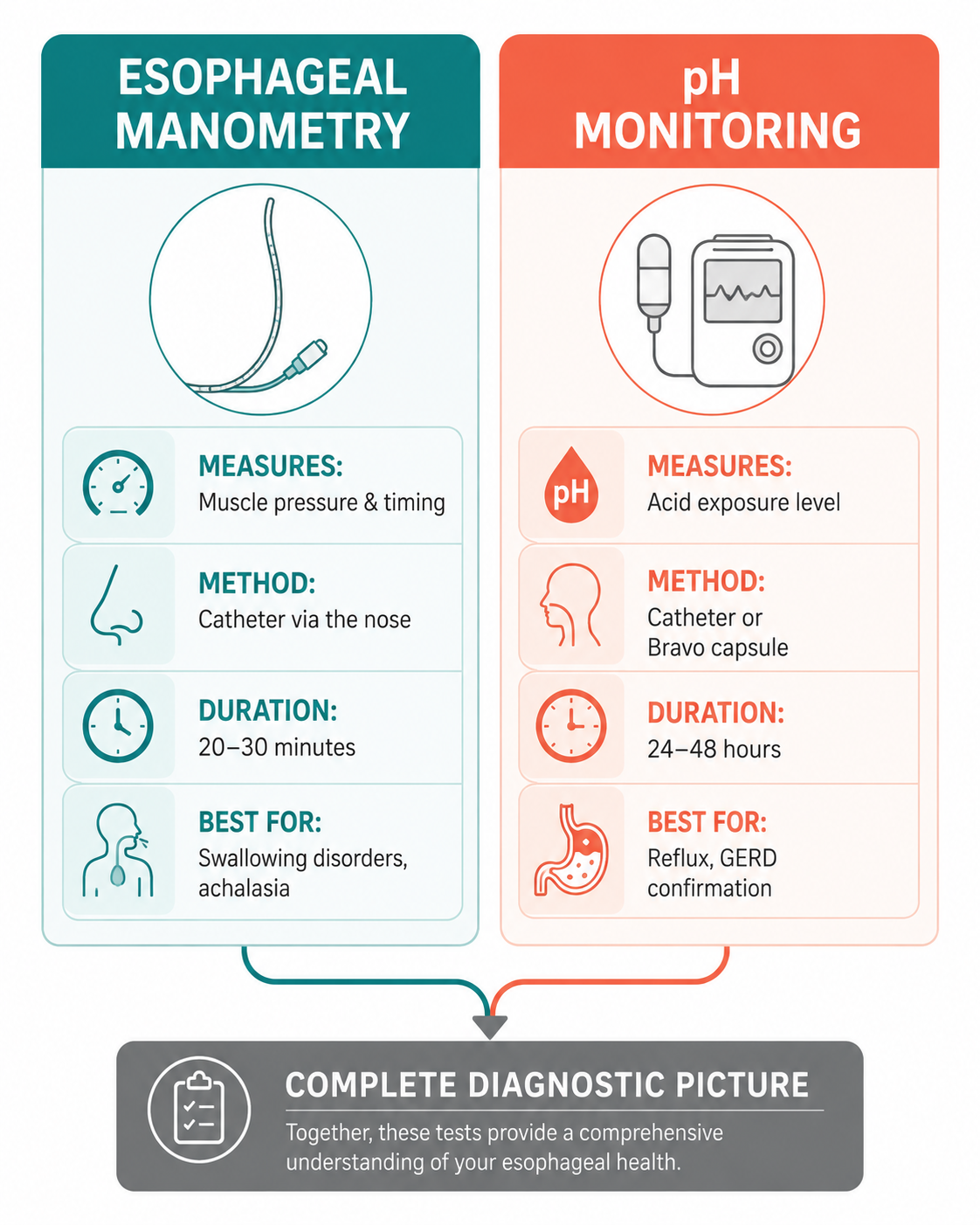
Esophageal manometry measures the pressure and coordination of the muscles in your esophagus, the tube connecting your throat to your stomach.
A thin, flexible catheter with pressure sensors is passed through the nose and down the esophagus, and as you swallow small sips of water, it records exactly how (and how well) those muscles contract. It’s checking function, not acid.
pH monitoring, on the other hand, measures acid exposure. Depending on the method (a 24-hour catheter, a wireless Bravo capsule attached to the esophageal lining, or combined impedance-pH testing), it tracks how often stomach acid backs up into the esophagus and for how long, correlating that with what you’re eating, doing, and feeling symptom-wise over the monitoring period.
According to the National Institute of Diabetes and Digestive and Kidney Diseases (NIDDK), pH monitoring works by having the patient wear a recorder that logs acid levels alongside diet, sleep, and symptom timing. That gives doctors a way to confirm a GERD diagnosis or check whether current treatment is actually working.
One test asks “does the plumbing work?” The other asks “is there actually acid where it shouldn’t be?” Rarely do you get the full picture from just one.
Who Actually Needs These Tests?
Not everyone with heartburn needs to go anywhere near a manometry catheter. Most reflux is diagnosed and treated perfectly well based on symptoms and a trial of medication.
These tests earn their place when something doesn’t add up: when reflux symptoms don’t respond to standard treatment, when swallowing itself feels wrong rather than just painful, or when a surgeon needs a clear picture of esophageal function before operating.
Patients get referred for manometry and pH testing for a mix of reasons: chronic heartburn that hasn’t budged after two months of proton pump inhibitors, difficulty swallowing solids or liquids, unexplained chest pain once cardiac causes are ruled out, chronic cough or hoarseness that might be silent reflux rather than a throat problem, and pre-surgical workups before anti-reflux or bariatric procedures.
Suspected motility disorders like achalasia sit here too. These are conditions where the esophagus itself has essentially stopped coordinating properly, which is a very different problem from simple acid reflux.
It’s also worth knowing the difference between garden-variety acid reflux and a formal GERD diagnosis. Occasional reflux happens to almost everyone, but when it’s frequent enough to damage the esophagus or disrupt daily life, that’s a different category of problem, and one worth investigating properly.
The Benefits of Esophageal Manometry
Manometry’s biggest strength is that it rules things in and out with real precision. A doctor can suspect achalasia from symptoms alone, but manometry is what confirms it, showing the characteristic failure of the lower esophageal sphincter to relax, paired with absent or abnormal contractions further up.
Patients with achalasia often spend years being treated for reflux before the actual diagnosis surfaces, which is part of why this test matters so much when swallowing itself, not just burning, is the complaint.
Most patients assume the test will hurt. Honestly, it doesn’t. It’s uncomfortable for the few minutes the catheter is being passed and positioned, similar to the sensation of a nasogastric tube, but there’s no sedation required, and you’re back to normal activities within the hour. That surprises people every time.
Manometry also plays a specific pre-surgical role. Before any anti-reflux surgery (fundoplication, for instance), a surgeon needs to know the esophagus is contracting normally.
Operating on someone with an undiagnosed motility disorder can make swallowing worse, not better, so this test is often a non-negotiable step before the operating room, not an optional extra.
Where manometry differs from endoscopy is worth spelling out too, since patients often ask why they need “another” procedure. Endoscopy looks at the lining of the esophagus: inflammation, ulcers, Barrett’s changes.
Manometry looks at how the muscle moves. You can have a perfectly normal-looking esophagus on endoscopy and still have a significant motility problem that only manometry will catch.
The Benefits of pH Monitoring
If manometry answers the “how does it move” question, pH monitoring answers “is acid actually the culprit.” This distinction matters more than it sounds like it should, because plenty of patients with reflux-like symptoms (chest pain, throat clearing, cough) turn out to have normal acid exposure. Treating them indefinitely with acid suppression doesn’t fix anything if acid was never the real issue.
The 24-hour ambulatory pH test remains the most detailed option, giving a full day-and-night picture including meals, sleep, and symptom diary correlation. The Bravo capsule trades a day of catheter-in-nose discomfort for a wireless sensor clipped to the esophageal lining, which most patients find far more tolerable, though it typically only captures 48 hours rather than continuous multi-day data in some setups.
Combined impedance-pH testing goes a step further, picking up non-acid reflux episodes that a standard pH probe would miss entirely. That’s useful in patients still symptomatic despite acid suppression, where the reflux may be happening but isn’t acidic anymore.
The American College of Gastroenterology’s 2022 clinical guideline on GERD diagnosis and management addresses exactly this scenario: when symptoms suggest reflux but endoscopy doesn’t confirm it clearly, reflux monitoring off medication is the recommended next step to settle the diagnosis one way or the other. In other words, when the picture is murky, this test is often what actually settles it, not another round of empiric medication.
How These Tests Work Together
This is the part that tends to get skipped over in most articles on the topic, but it’s arguably the most useful thing to understand: manometry and pH studies are frequently ordered as a pair precisely because they answer different questions, and either one alone can miss something the other would catch.
A patient scheduled for anti-reflux surgery is the clearest example. The surgeon needs the pH study to confirm there’s genuine pathological acid exposure worth operating on, and needs the manometry to confirm the esophagus will still function properly once the anatomy is altered. Skip either one, and you risk operating on the wrong problem or creating a new one. It’s a similar logic to why patients get regular gastroenterologist visits built into their care in the first place: catching the full picture early tends to prevent bigger interventions later.
For patients with overlapping symptoms, say, both dysphagia and heartburn, running both tests in the same visit also just saves time. Rather than treating empirically, waiting to see what improves, and then investigating further if nothing changes, both tests together can shortcut months of trial-and-error.
What to Expect: Preparation, Procedure, and Recovery
Preparation for both tests is fairly similar and not particularly onerous, though it does require some discipline in the days beforehand.
Before the test:
You’ll typically be asked to stop certain medications (proton pump inhibitors, H2 blockers, and sometimes prokinetics) for anywhere from a few days to two weeks beforehand, since these can mask the very acid exposure the test is trying to measure. Fasting for several hours before the procedure is standard.
During manometry:
The catheter is passed through the nose, positioned in the esophagus, and you’ll be asked to swallow small amounts of water on cue while the machine records pressure readings. The whole thing usually takes 20–30 minutes.
During pH monitoring:
Either a thin catheter stays in place for 24 hours (removed the next day), or a Bravo capsule is placed during a brief endoscopic procedure and transmits data wirelessly before naturally detaching and passing through your system days later. You’ll keep a diary of meals, symptoms, and sleep/wake times throughout.
After:
There’s minimal downtime. Some mild throat irritation or a scratchy feeling for a day is common with catheter-based tests, but most patients are back to normal eating and activity immediately.
If a swallowing study or scope is part of your workup, it can help to understand what a gastroscopy involves beforehand too, since the prep and mindset are broadly similar.
Getting Your Results, and What Happens Next
Results aren’t usually available on the day. Manometry pressure readings and pH data both need to be processed and reviewed properly, which typically takes anywhere from a few days to about two weeks depending on the practice. It’s worth asking upfront how results will be communicated. Some patients get a phone call, others a follow-up appointment, and for anything that might change the treatment plan significantly, an in-person discussion is usually better than a message.
What happens next depends entirely on what the tests actually show. Normal acid exposure with normal motility often means looking elsewhere for the cause of symptoms.
Sometimes that turns out to be a hiatal hernia, a functional disorder, or something outside the esophagus altogether. If you’ve had ongoing symptoms with no clear digestive cause, it’s worth reading up on when hiatal hernia symptoms cross into something that needs attention, since the two conditions get confused fairly often.
Abnormal results, on the other hand, usually open up a specific conversation, whether that’s adjusting medication, considering surgery, or in the case of motility disorders like achalasia, discussing options like balloon dilation or myotomy. Either way, the value of these tests isn’t just the diagnosis itself.
It’s that the next step actually has evidence behind it, rather than being another guess in a long line of guesses. That’s really the whole point of taking acid reflux seriously rather than living around it indefinitely. The earlier the mechanism is understood, the fewer complications tend to build up over time.
When to Talk to a Gastroenterologist in Pretoria
If reflux medication isn’t working after a couple of months, or if swallowing itself has started to feel effortful rather than just uncomfortable, that’s generally the point to stop self-managing and get a proper evaluation. Chest pain that’s been cleared by a cardiologist but keeps recurring is another common trigger for referral, and a reasonable one, since esophageal pain and cardiac pain can genuinely feel identical.
Dr. Preetha Thomas, a specialist physician and gastroenterologist in Pretoria, regularly sees patients who’ve spent years cycling through antacids and lifestyle changes before anyone actually tested what was happening mechanically in the esophagus. That gap, between symptom and diagnosis, is exactly what manometry and pH studies are designed to close.
Book a Consultation with Dr Preetha Thomas
If any of this sounds familiar, chronic heartburn that won’t quit, swallowing that’s started to feel like work, or chest pain that keeps coming back with no cardiac cause, it’s worth having a proper conversation rather than reaching for another round of antacids. Get in touch to book a consultation and find out whether manometry, pH monitoring, or both are the right next step for you.
Frequently Asked Questions
Is manometry testing painful?
Not painful, but uncomfortable for the few minutes the catheter is being passed. Most people compare it to the sensation of a nasogastric tube. No sedation is needed and it’s over quickly.
How long does a pH monitoring test take?
Standard catheter-based monitoring runs 24 hours. The Bravo capsule version typically captures 48 hours of data, and you go about your normal routine the entire time.
What does an abnormal manometry result mean?
It depends on the pattern. It could point to achalasia, diffuse esophageal spasm, or a weak lower esophageal sphincter, among other things. Your gastroenterologist will interpret the specific pressure pattern against your symptoms rather than reading it in isolation.
Do I need both manometry and a pH study?
Not always. It depends on your symptoms. Straightforward reflux that responds to medication rarely needs either. They become important when symptoms are unclear, unresponsive to treatment, or when surgery is being considered.