


Almost everyone gets heartburn now and then, a spicy meal, too much coffee, eating too late and then lying down. It’s uncomfortable, but it passes. The harder question is what to do when it doesn’t pass, when it keeps coming back week after week, and the antacids in your kitchen drawer start feeling less like an occasional fix and more like a daily requirement.
This is where a lot of people get stuck. Is this still “just heartburn,” or has it become something that needs a specialist’s attention? Here’s how to tell the difference, and when it’s genuinely time to book that appointment.
What Counts as Persistent or Chronic Heartburn?
Occasional heartburn, once or twice a month after a particularly rich meal, isn’t usually a concern. The line most doctors use is frequency: heartburn that happens more than twice a week, or that’s been going on for several weeks straight, is generally considered chronic rather than occasional.
This is different from something like food poisoning or a stomach bug, which tend to cause sudden, short-lived symptoms that resolve within a day or two. Persistent heartburn doesn’t follow that pattern. It lingers, it recurs, and it doesn’t resolve on its own the way a passing stomach illness does.
Frequent heartburn that keeps returning despite basic changes, eating earlier, cutting back on trigger foods, using antacids, is the pattern that typically prompts a referral. If you’ve found yourself reaching for an antacid almost daily, or heartburn is starting to interrupt sleep or meals on a regular basis, that’s not something to just push through indefinitely.
It’s also worth paying attention to how your symptoms are trending, not just how often they occur right now. Heartburn that started as an occasional nuisance a year ago and has gradually crept up to two or three times a week deserves a different response than heartburn that’s remained mild and infrequent for years.
Gradual progression is often a sign that whatever mechanism is causing the reflux, whether that’s weight gain, a developing hiatal hernia, or something else, is getting more pronounced over time, and that’s worth investigating rather than simply adjusting to.
Common Heartburn Causes
Heartburn happens when stomach acid moves back up into the oesophagus, and there’s usually a reason it’s happening more than it should. Common contributors include:
- Certain foods and drinks, spicy or fatty meals, citrus, chocolate, caffeine, alcohol
- Eating large meals or eating too close to bedtime
- Being overweight, which increases pressure on the stomach
- Smoking, which weakens the valve that normally keeps acid down
- Pregnancy
- Certain medications
- A hiatal hernia, a condition where part of the stomach pushes up through the diaphragm, which can make reflux considerably more likely
Most people can point to at least one or two of these when they think about their own pattern. That’s useful information, but it doesn’t always explain why heartburn has become frequent rather than occasional, which is often where a doctor’s evaluation adds real value.
Age is also a factor that doesn’t get discussed enough. The muscle that normally keeps stomach acid where it belongs, the lower oesophageal sphincter, can weaken gradually over time, which is part of why reflux tends to become more common, and more persistent, later in life even without major changes to diet or weight.
This doesn’t mean chronic heartburn is simply an inevitable part of ageing to accept, but it does mean the cause isn’t always something you did wrong, sometimes it’s simply a mechanical change that’s worth addressing directly with a specialist rather than through trial and error alone.
Persistent Acid Reflux vs. GERD: What’s the Difference?
These two terms get used almost interchangeably, but they’re not quite the same thing. Acid reflux is the physical event, stomach acid moving up into the oesophagus. Heartburn is the symptom that results from it.
GERD, or gastroesophageal reflux disease, is the diagnosis given when reflux happens often enough, and severely enough, to be considered a chronic condition rather than an occasional annoyance.
According to Mayo Clinic, most people experience acid reflux from time to time without it becoming a medical concern, but when it happens repeatedly, it can progress into GERD, a condition that generally does require ongoing management rather than the occasional antacid.
GERD Symptoms Beyond Heartburn
Heartburn tends to get all the attention, but GERD can show up in ways that don’t feel like classic heartburn at all. These include regurgitation of food or sour liquid, a chronic cough, hoarseness, a sensation of a lump in the throat, and even worsening asthma-like symptoms in some cases.
This overlap is part of why silent reflux often goes undiagnosed for a long time. Someone dealing with a persistent throat clear, hoarseness, or a nagging cough may never connect it to their digestive system at all, and end up treating the symptom rather than the underlying cause.
Is It Heartburn or Something More Serious? GERD and Chest Pain vs. Heart Attack
This is the part of the conversation that deserves the most directness. Because the oesophagus sits close to the heart, both heartburn and a heart attack can produce chest pain that feels remarkably similar, and even experienced doctors sometimes can’t tell the difference from a description alone.
There are some general patterns. Heartburn typically produces a burning sensation behind the breastbone, often after eating, and tends to ease with antacids. A heart attack more often feels like pressure, tightness, or squeezing, and may spread to the jaw, arm, or back. Mayo Clinic notes that heart attack symptoms typically don’t resolve with medication the way heartburn usually does, since the underlying cause is a blocked artery rather than acid.
That said, none of these patterns are reliable enough to self-diagnose from. If you’re experiencing severe chest pain, especially combined with shortness of breath, pain radiating to the arm or jaw, sweating, or lightheadedness, treat it as a medical emergency and seek immediate care.
It’s always better to be evaluated and find out it was heartburn than to assume it’s heartburn and be wrong.
What Happens If Chronic Acid Reflux Goes Untreated?
Chronic acid reflux isn’t just uncomfortable, over time, repeated acid exposure can actually damage the lining of the oesophagus. This can progress to esophagitis, inflammation and irritation that can cause pain, bleeding, or difficulty swallowing.
In a smaller number of cases, long-term untreated reflux can lead to Barrett’s oesophagus, a condition in which the tissue lining the oesophagus changes in response to repeated acid exposure.
Barrett’s oesophagus itself doesn’t usually cause symptoms beyond the underlying reflux, but it’s associated with a modestly increased risk of oesophageal cancer over time, which is precisely why doctors take persistent, long-standing reflux seriously rather than treating it as a purely lifestyle issue.
None of this means everyone with frequent heartburn is heading toward a serious complication. Most people who get appropriate treatment do well. But it does mean that “just living with it” carries a real, if often small, cumulative risk that’s worth addressing rather than ignoring indefinitely.
The timeline here matters too. These complications generally develop over years of untreated or poorly controlled reflux, not weeks or months, which is exactly why chronic heartburn deserves a proper look sooner rather than later.
Catching and managing reflux early is a far simpler process than addressing esophagitis or Barrett’s oesophagus after years of ongoing acid exposure, and it typically means a much less involved treatment path overall.
Heartburn Treatment: From Antacids to Prescription Options
Treatment for heartburn tends to follow a fairly predictable escalation. For occasional heartburn, over-the-counter antacids that neutralise stomach acid are often enough.
For more frequent symptoms, H2 blockers or proton pump inhibitors, which reduce how much acid the stomach produces in the first place, are commonly used and tend to be more effective for regular, ongoing reflux.
If symptoms persist despite these options, a gastroenterologist may look at other prescription-strength medications, or investigate whether something structural, like a hiatal hernia, is contributing to the problem.
In select cases where medication alone isn’t providing adequate control, procedural or surgical options may be discussed, though this is generally further down the list rather than a first step.
It’s worth noting that long-term reliance on certain acid-reducing medications isn’t necessarily risk-free, and a doctor’s input is genuinely useful here, both for confirming the medication is working as intended and for reassessing whether the underlying cause has actually been addressed.
Self-adjusting doses, or taking a stronger medication than needed simply because it’s available over the counter, isn’t a substitute for this kind of periodic reassessment.
Reflux medications work by different mechanisms, and what controls symptoms well for one person may be poorly matched to another person’s actual cause, particularly when a hiatal hernia or a swallowing issue is part of the picture rather than acid production alone.
This is exactly the kind of nuance a gastroenterologist is positioned to sort out, in a way that simply escalating to a stronger over-the-counter option isn’t.
Lifestyle Changes That Help Manage Acid Reflux
Alongside medication, a handful of lifestyle adjustments consistently show up as genuinely useful for managing reflux:
- Eating smaller meals rather than large ones
- Avoiding known trigger foods, common culprits include fatty or fried foods, citrus, tomato-based products, chocolate, and caffeine
- Staying upright for a few hours after eating rather than lying down
- Elevating the head of the bed slightly if nighttime symptoms are a particular problem
- Working toward a healthy weight, since excess weight increases pressure on the stomach
- Cutting back on alcohol and quitting smoking
These changes won’t resolve every case on their own, particularly where GERD or a hiatal hernia is driving the symptoms, but they meaningfully reduce frequency and severity for a lot of people, and they’re worth trying alongside, not instead of, medical guidance.
Severe Heartburn: When Self-Treatment Isn’t Enough
There’s a point where self-management stops being a reasonable strategy on its own. If you’re taking antacids multiple times a week, if over-the-counter options that used to work no longer provide relief, or if symptoms are affecting sleep, eating, or daily activities, that’s a sign the underlying cause needs proper evaluation rather than continued self-treatment.
It’s also worth paying attention to whether medication side effects are becoming part of the equation. Long-term use of certain heartburn medications can occasionally raise its own concerns, which is another reason ongoing self-treatment without medical oversight isn’t ideal once symptoms have become frequent or severe.
When Should You See a Doctor for Heartburn?
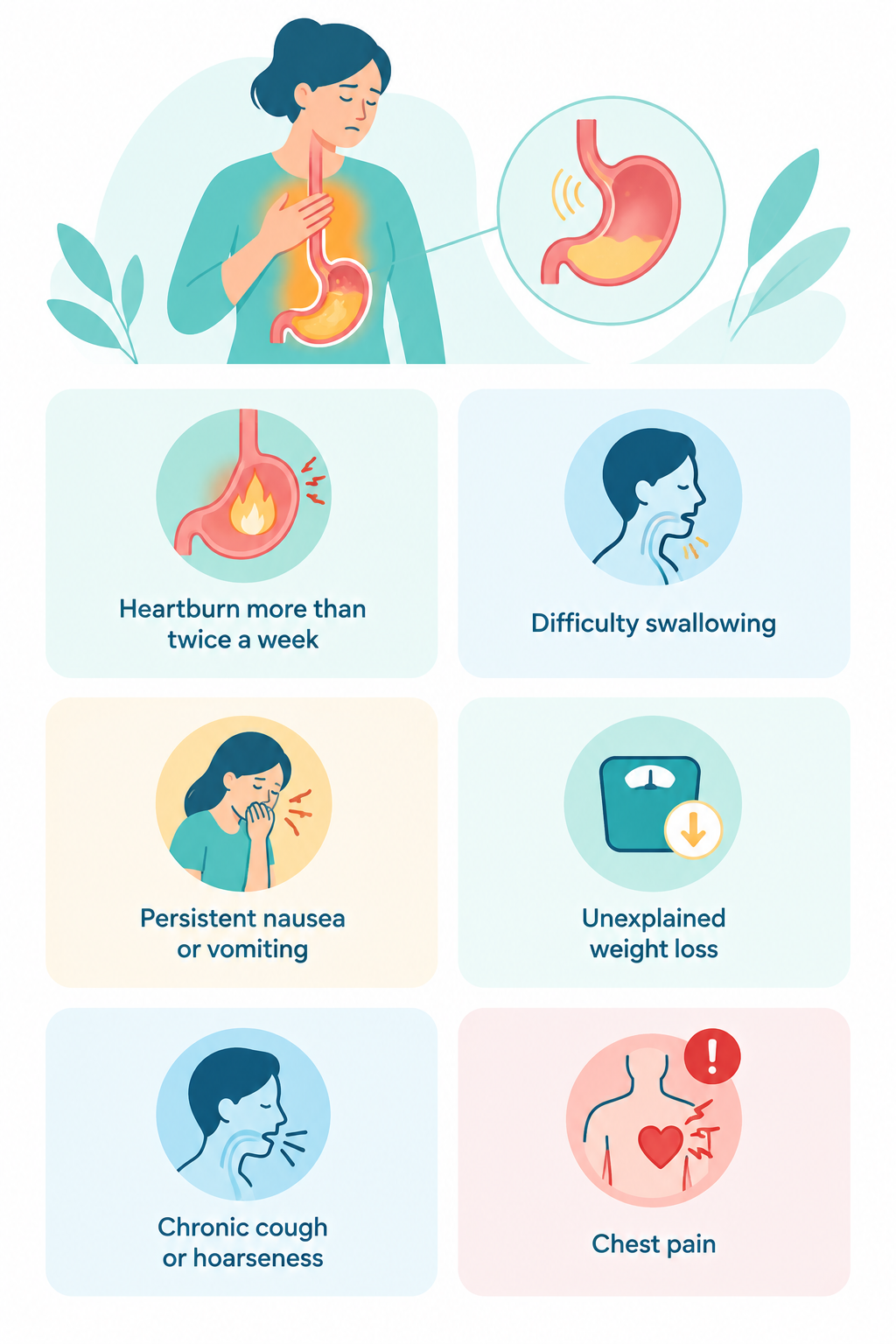
As a general guide, it’s time to see a doctor, and likely be referred to a gastroenterologist, if you experience any of the following:
- Heartburn more than twice a week
- Symptoms that persist despite regular use of over-the-counter medication
- Difficulty or pain when swallowing
- Persistent nausea or vomiting
- Unexplained weight loss
- Chest pain that’s new, severe, or accompanied by other concerning symptoms (treat this as an emergency, not a scheduling decision)
- A chronic cough, hoarseness, or throat symptoms without an obvious cause
- Heartburn that’s been present for several weeks with no improvement
If more than one of these applies to you, that’s a reasonably strong signal that it’s time for a proper evaluation rather than continuing to manage things on your own.
How a Gastroenterologist Diagnoses the Cause of Persistent Heartburn
A specialist visit for persistent heartburn usually starts with a detailed history, when symptoms happen, what triggers them, and what’s already been tried. From there, further testing depends on the individual case.
An upper endoscopy allows a gastroenterologist to directly examine the lining of the oesophagus and stomach, check for inflammation, hiatal hernia, or early signs of Barrett’s oesophagus, and take a biopsy if needed.
In some cases, pH monitoring may be used to measure how much acid is actually reaching the oesophagus and how that correlates with symptoms, which is particularly useful when the diagnosis isn’t entirely clear from history and endoscopy alone.
Manometry, which measures the muscular function of the oesophagus, may also be used if a swallowing problem is part of the picture.
The goal of all of this isn’t just to confirm that reflux is happening, most people already know that part, it’s to understand why it’s happening and whether anything beyond simple GERD is contributing, so treatment can actually target the cause rather than just managing symptoms indefinitely.
It’s also worth knowing that a referral for testing doesn’t automatically mean something serious has been found. Endoscopy in particular is a routine, well-tolerated procedure, and for a large proportion of patients, it simply confirms mild irritation or a hiatal hernia that can be managed effectively once identified.
The value of the test isn’t in expecting bad news, it’s in replacing guesswork with an actual answer, which usually makes treatment more targeted and more effective than continuing to adjust medications and lifestyle habits without knowing exactly what’s driving the reflux in the first place.
Ready to Get Answers for Your Persistent Heartburn?
If heartburn has become a regular part of your week rather than an occasional annoyance, it’s worth finding out why rather than continuing to manage it alone.
Dr. Preetha Thomas, gastroenterologist in Pretoria, provides thorough evaluation and treatment for chronic reflux and related digestive conditions. Book a consultation to get a clear answer and a treatment plan that actually addresses the cause.
Frequently Asked Questions
Can stress cause chronic heartburn?
Stress doesn’t directly cause reflux, but it can make existing symptoms feel worse and may influence habits, eating faster, drinking more caffeine or alcohol, that contribute to heartburn. Managing stress is a reasonable part of an overall management plan, though it’s rarely the sole cause.
Is heartburn every day a sign of GERD?
Daily or near-daily heartburn is a strong signal that reflux has become chronic and is worth evaluating, since GERD is generally defined by frequency and persistence rather than the severity of any single episode.
Can heartburn go away on its own?
Occasional, mild heartburn linked to specific triggers often resolves once those triggers are addressed. Chronic heartburn that’s been present for weeks or months typically doesn’t resolve without some form of treatment or lifestyle change.
Is silent reflux dangerous if untreated?
Silent reflux carries the same underlying risks as typical GERD, potential damage to the oesophagus and airway over time, but because it doesn’t always cause obvious heartburn, it’s more likely to go undiagnosed and untreated for longer, which can allow complications to progress further before being caught.
How is GERD officially diagnosed?
GERD is typically diagnosed based on a combination of symptom history and, where needed, testing such as upper endoscopy or pH monitoring, particularly if symptoms are severe, atypical, or not responding to standard treatment.
Disclaimer: This article is intended for general informational and educational purposes only. It does not constitute medical advice and should not be used to diagnose, treat, or manage any health condition. If you are experiencing severe or new chest pain, seek emergency medical care immediately rather than relying on this article to distinguish heartburn from a heart attack. Please consult Dr. Preetha Thomas or another qualified gastroenterologist regarding your specific symptoms and treatment options.